
What Is a Machine Vision PC? Vision Controllers in Automated Production Lines
Introduction
Walk into any modern automated factory and you’ll find cameras inspecting products, measuring dimensions, reading barcodes, identifying defects, and guiding robots. But cameras alone cannot make decisions. Behind every successful machine vision system lies a powerful computing platform: a Machine Vision PC (also called a vision controller).
As manufacturers adopt Industry 4.0, machine vision has become essential for improving quality, cutting labor costs, and boosting efficiency. But what exactly does a Machine Vision PC do, and why is choosing the right hardware just as important as selecting the right camera?
What Is a Machine Vision PC?
A Machine Vision PC is an industrial computer designed to process images captured by industrial cameras and turn them into actionable information.
Think of the system as a human-like process:
| Component | Role |
|---|---|
| Camera | The eyes – captures images |
| Machine Vision PC | The brain – analyzes images using software or AI |
| PLC / Robot | The hands – executes sorting, rejection, or assembly commands |
Without the computing power of a vision controller, industrial cameras simply collect pictures – they cannot inspect, measure, or guide.
Where Are Machine Vision PCs Used?
Machine vision systems are found across nearly every manufacturing sector.
✅ Quality Inspection
Detects surface scratches, cracks, missing components, label defects, and assembly errors. Industries: electronics, semiconductor, automotive, medical devices, food packaging.
✅ Barcode & OCR Reading
Automatically reads QR codes, serial numbers, batch numbers, and traceability labels, then uploads data directly to MES or ERP.
✅ Precision Measurement
Measures diameter, length, width, hole position, and component alignment with micron-level accuracy and consistency.
✅ Robot Guidance
Enables robots to locate object position, orientation, and angle for pick-and-place operations in packaging lines, logistics, and electronic assembly.
Why Hardware Quality Is Often Overlooked – Yet Critical
Many companies focus heavily on cameras and software while underestimating the vision controller. However, hardware limitations are the #1 source of system instability in real-world deployments.
🔌 Network Bottlenecks
GigE industrial cameras continuously transmit large amounts of image data. Low-quality network controllers cause packet loss, frame drops, and inspection errors. Professional machine vision systems require industrial-grade Ethernet controllers (e.g., Intel I210/I211) that support jumbo frames and hardware timestamping.
🧩 USB Bandwidth & Channel Isolation
A common trap: more USB ports isn’t always better. Many industrial PCs share a single USB controller across multiple ports, causing bandwidth contention when connecting several high-resolution cameras simultaneously – leading to disconnections or dropped frames.
What a well-designed vision PC does: The CESIPC UPC-302D provides up to 9 native USB ports with independent channel design (multiple USB 3.0 host controllers). This ensures each camera receives dedicated bandwidth, making it ideal for multi-camera AOI (Automated Optical Inspection) and synchronous inspection applications.
🌡️ Heat & Continuous Operation
Production lines run 24/7. Office-grade PCs throttle performance when hot. A machine vision PC must withstand continuous 100% CPU/GPU load without thermal throttling. Industrial solution: Fanless cooling with a sealed aluminum chassis. No moving parts means no dust intake, no fan failure, and stable operation in high-temperature environments (e.g., -20°C to 70°C for wide‑temperature SKUs).
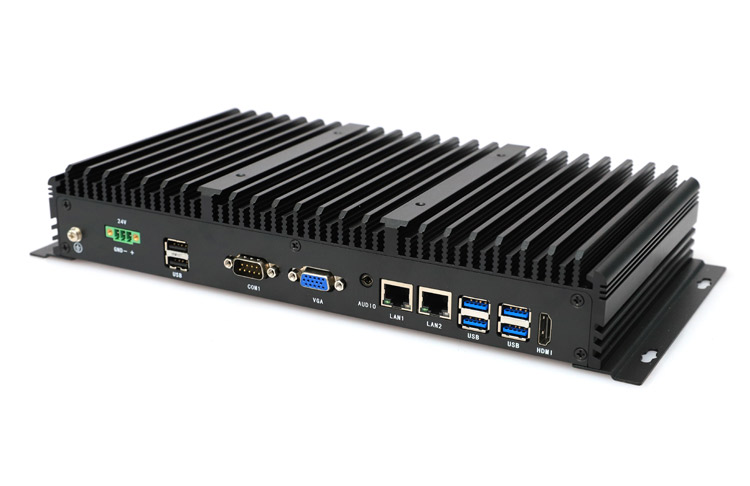
CESIPC UPC-302D Industrial Vision PC
Up to 9 native USB ports | Independent USB channels | Dual Intel LAN | Fanless | 9–36V wide input | -10°C to 60°C operation
Explore UPC-302D →What Makes a Good Machine Vision PC? – A Quick Checklist
Based on real-world deployment experience, a reliable vision controller should have:
| Feature | Why It Matters |
|---|---|
| High-performance Intel processor | Handles complex vision algorithms & AI |
| Multiple native USB 3.0 (with independent controllers) | Connects several cameras without hubs or bandwidth issues |
| Dual Intel Gigabit LAN | Isolates camera network from factory MES network |
| Fanless, wide‑temperature design | Eliminates dust‑related failures; reliable 24/7 |
| Industrial SSD (e.g. M.2 NVMe) | Fast boot & data logging, vibration‑resistant |
| Wide voltage input (9–36V DC) | Stable operation despite factory power fluctuations |
| 24/7 operation rating | Designed for continuous duty, not office use |
Real‑World Example: CESIPC UPC‑302D for Multi‑Camera Vision Systems
The CESIPC UPC‑302D is an industrial panel PC / vision controller designed for demanding environments where connectivity and reliability are paramount.
🔹 Key Differentiator: Intelligent USB Design
Unlike many industrial PCs that advertise “lots of USB ports” but share internal bandwidth, the UPC‑302D offers up to 9 USB ports (including multiple USB 3.0) with separate controller channels. This engineering choice eliminates the common “camera disconnect” issue when running three or more high‑resolution sensors simultaneously – a critical requirement for AOI and multi‑station inspection lines.
🔹 Additional Vision‑Friendly Features
- Fanless thermal design: -10°C to 60°C operating range (optional wide‑temp)
- Dual Intel Gigabit LAN for camera + network isolation
- 9–36V DC wide input with over‑current protection
- Industrial‑grade SSD with vibration resistance
- Rich expansion: COM ports for PLCs, HDMI, audio, etc.
“We deployed over 80 UPC‑302D units in our semiconductor packaging line, each running four 5MP GigE cameras. After 18 months of 24/7 operation, zero hardware‑related failures. The independent USB channels solved our previous frame drop problems completely.”
– Senior Automation Engineer, Tier‑1 Semiconductor Equipment Manufacturer
Machine Vision vs. Traditional Industrial PC: A Quick Comparison
| Feature | Standard Industrial PC | Vision‑Optimized PC (e.g. UPC‑302D) |
|---|---|---|
| USB design | Shared controller | Multiple independent controllers |
| Ethernet | Single GbE | Dual Intel GbE with jumbo frame support |
| Cooling | Active (fan) | Fanless, wide‑temp capable |
| Power input | 12V fixed | 9–36V wide range |
| MTBF (typical) | ~30,000 hours | >80,000 hours |
| Best for | HMI, data logging | Multi‑camera inspection, AI vision |
Common Selection Mistakes – What to Avoid
- ❌ Counting USB ports without checking controller architecture – leads to bandwidth bottlenecks.
- ❌ Using office‑grade SSDs – they fail quickly in vibration‑prone factory environments.
- ❌ Ignoring thermal management – CPU throttling causes random inspection timeouts.
- ❌ Overlooking network isolation – mixing camera traffic and MES traffic on one LAN invites packet collisions.
The Future of Machine Vision in Smart Manufacturing
As production lines evolve, machine vision is expanding beyond inspection into:
- AI‑powered defect detection (deep learning)
- Predictive quality analytics
- Autonomous robot guidance
- Real‑time production monitoring
- Edge AI visual processing
All these technologies depend on reliable, high‑throughput computing platforms that can handle increasing image data rates. The Machine Vision PC is no longer a supporting component – it has become the core processing engine behind intelligent manufacturing.
Conclusion
Machine vision transforms production lines by improving accuracy, consistency, and efficiency. While cameras capture images, the vision controller performs the critical processing that turns pixels into production decisions.
For manufacturers building inspection systems, robot guidance solutions, or automated quality control platforms, choosing the right vision PC is as important as choosing the right camera.
With its independent USB channel design, dual Intel LAN, fanless ruggedness, and proven reliability in semiconductor and electronics manufacturing, the CESIPC UPC‑302D offers a practical, scalable foundation for today’s vision applications – and tomorrow’s smart factories.
Need help selecting a vision controller for your multi‑camera system?
Contact Engineering Team →
Talk to a CESIPC Engineer
Our application engineers are ready to help you select the right configuration, discuss ODM requirements, or provide a tailored quotation for your project.
Typical response within 24 hours · Multilingual support · CE / FCC / BIS compliant


We use your details only to answer this enquiry — no newsletters, no sharing. Drawings or a photo of the existing panel can be sent to sales@cesipc.com.