



Why Harvesting Robots Need an Industrial PC for 4 Cameras
Agricultural automation is rapidly transforming the farming industry. From autonomous tractors to AI-powered harvesting robots, modern farms are becoming smarter, more efficient, and less dependent on manual labor.
Among these technologies, harvesting robots have gained significant attention for their ability to identify, locate, and pick fruits and vegetables with high precision.
However, behind every successful harvesting robot is a powerful vision system, and behind that vision system is a reliable industrial computer capable of handling multiple cameras simultaneously.
This is why many agricultural equipment manufacturers are now searching for an industrial PC for 4 cameras.
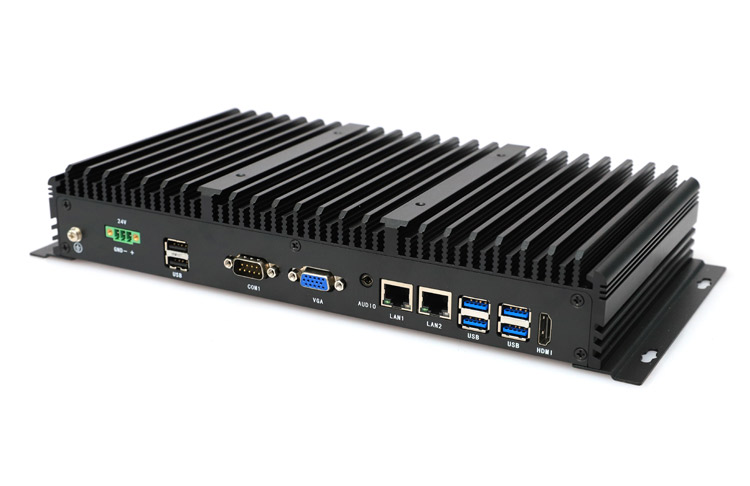
CESIPC UPC-302D Industrial PC
Up to 9 native USB ports | Fanless | Intel platform | 9–36V wide input | Compact embedded design
Explore UPC-302D →Why Do Harvesting Robots Use Multiple Cameras?
A harvesting robot doesn’t simply “see” like a human. Instead, it collects visual information from several different perspectives at the same time.
A typical robot may use:
- Front Camera – Used for navigation and route planning.
- Fruit Detection Camera – Used to identify ripe fruits based on color, shape, and size.
- Depth Camera – Used to calculate the distance between the robotic arm and the fruit.
- Side Camera – Used to monitor surrounding obstacles such as branches, leaves, or support structures.
Each camera generates a continuous stream of image data that must be processed in real time. This means the industrial computer must be capable of connecting and managing multiple cameras without introducing delays or communication instability.
The Challenge of Connecting Four Cameras
Many conventional industrial computers only provide 2 to 4 USB ports. When system integrators begin adding four industrial cameras, GPS modules, AI accelerators, wireless communication devices, external storage, sensors, and control modules, the available USB ports quickly become insufficient.
As a result, many developers rely on external USB hubs. Unfortunately, USB hubs often create new problems: bandwidth limitations, camera disconnections, data packet loss, increased system complexity, and reduced reliability in outdoor environments.
For agricultural robots operating in remote fields, these issues can directly impact harvesting efficiency.
When multiple cameras are connected directly to the industrial PC, each camera receives a dedicated communication channel. This offers:
- Higher data stability – image streams remain consistent during long operating periods
- Lower latency – real-time object detection and robotic arm movement become more accurate
- Simplified system architecture – no additional USB hubs or adapters
- Better long-term reliability – fewer components mean fewer points of failure
Industrial PC for 4 Cameras: A Practical Solution
The CESIPC UPC-302D is designed specifically for applications requiring multiple USB devices.
With multiple native USB interfaces available, system integrators can directly connect four industrial cameras, barcode scanners, GPS modules, sensor gateways, AI acceleration devices, and data storage devices without relying on external USB hubs.
Harvesting Robot Application Example
Consider an autonomous strawberry harvesting robot. The vision system may consist of:
| Device | Function |
|---|---|
| Camera 1 | Fruit detection |
| Camera 2 | Depth measurement |
| Camera 3 | Navigation |
| Camera 4 | Obstacle avoidance |
| GPS Module | Position tracking |
| SSD Storage | Image recording |
| AI Accelerator | Real-time inference |
A traditional IPC could quickly run out of available interfaces. A multi-USB industrial computer such as the UPC-302D allows all devices to be connected directly, improving system stability while simplifying integration.
Fanless Design for Agricultural Environments
Harvesting robots often operate in dusty fields, high-humidity greenhouses, outdoor orchards, and high-temperature environments. Cooling fans can draw dust, pollen, and moisture into the system, leading to premature hardware failure. A fanless industrial PC eliminates this risk by using passive cooling technology, helping maintain reliable operation even in challenging agricultural conditions.
The Future of Smart Agriculture
As AI vision technology continues to advance, harvesting robots will require more cameras, more sensors, and greater computing capability. The industrial computer is becoming the central processing hub that connects all these devices together.
Choosing an industrial PC for 4 cameras is no longer simply about having enough interfaces. It is about ensuring reliable vision processing, stable data transmission, accurate robotic operation, reduced maintenance costs, and long-term field deployment.
For agricultural equipment manufacturers and robot developers, a multi-USB industrial PC such as the CESIPC UPC-302D provides the connectivity foundation needed for next-generation harvesting automation.
Talk to a CESIPC Engineer
Our application engineers are ready to help you select the right configuration, discuss ODM requirements, or provide a tailored quotation for your project.
Typical response within 24 hours · Multilingual support · CE / FCC / BIS compliant


