
Industrial Panel PC for Pre-Operation Identification (RFID Integrated)
Designed for manufacturing environments and workstation access control, this CESIPC industrial panel PC integrates an RFID module to verify operator identity, work orders, and process authorization prior to operation.
It is widely used as an HMI and identification terminal in MES-driven production lines.

10inch RFID Panel PC
Enable operators to log in quickly and complete verification during pre-operation identification.
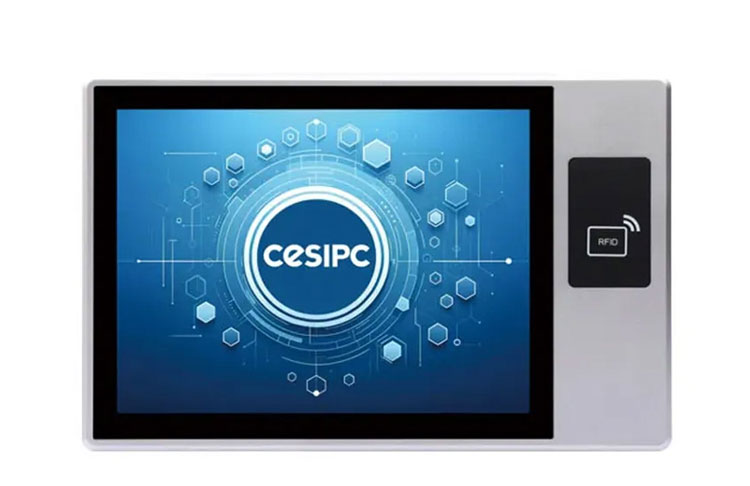
15inch RFID Panel PC
Enable personnel and work orders to be matched during pre-operation identification.
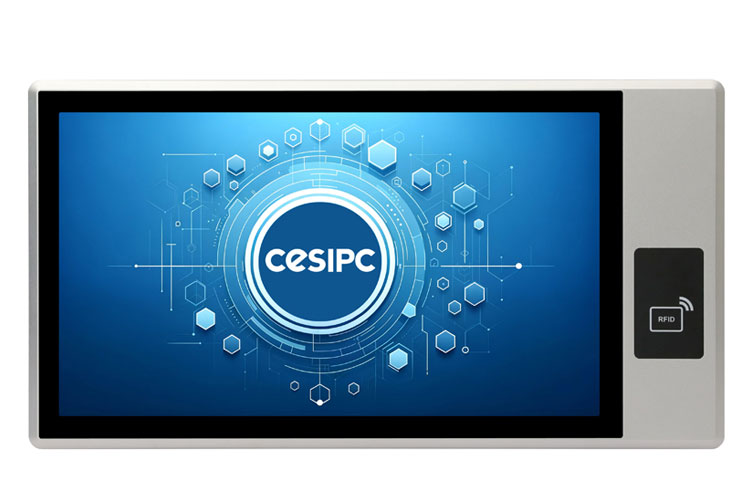
21.5inch RFID Panel PC
Present all pre-operation information centrally on a large-format display during identification.
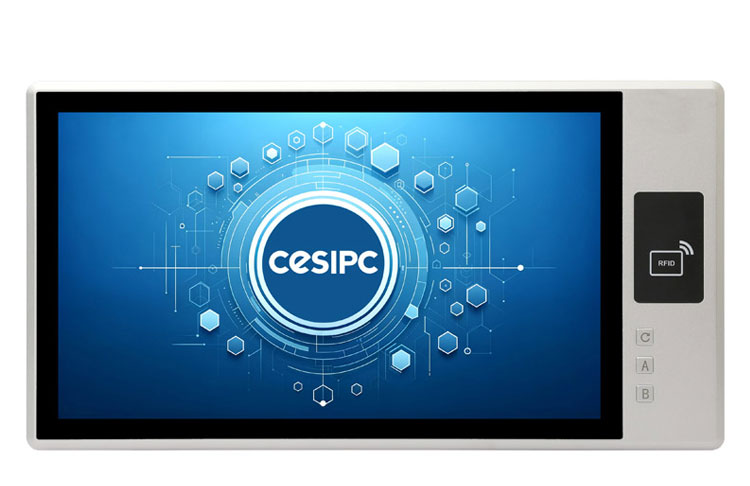
21.5inch RFID Panel PC(with DIY Keys)
Enable key operations to be executed quickly during pre-operation identification.
Optional HMI modules: Keys, Camera, Fingerprint, Face Recognition.
Product Features
- Supports both RS232 serial and USB HID RFID interface modes, compatible with different system architectures.
- Supports multiple RFID card standards, including IC cards and ID cards, selectable according to project requirements.
- Integrated RFID module and motherboard design, reducing external devices and cabling while improving overall system stability.
- USB HID plug-and-play support, requiring no drivers and simplifying system deployment and maintenance.
- Built on the LEGO MODE™ modular architecture, allowing computing power and functional modules to be configured on demand, with support for DIY expansion of keys, camera, fingerprint, and face recognition modules.
- Modular upgrades do not alter the overall system structure and do not affect thermal performance, EMC, or mechanical reliability.
- Avoids one-time over-configuration, supporting phased project upgrades and long-term scalability.
- Built-in SafeCore™ system-level stability design, enhancing reliability in industrial environments.
- Effectively reduces the impact of unexpected power loss on system operation and data integrity.
- Designed for 24/7 continuous operation in production lines and workstation applications.
- Offers multiple performance-level computing modules, covering low-power to high-performance application needs.
- Different computing platforms share a unified industrial design standard, ensuring consistent system stability.
- Computing upgrades do not change the I/O layout or usage, simplifying project transitions and system upgrades.
- A single device integrates HMI, RFID identification, and data acquisition, simplifying overall system architecture.
- Platform-based design is well suited for machine builders’ standard configurations and long-term OEM supply programs.
What makes our computers truly industrial-grade?
CESIPC Industrial Panel PCs are not just branded as "industrial-grade" – they are engineered to meet the rigorous demands of industrial environments, undergo extensive testing, and are certified for reliable performance in challenging conditions.

High Reliability & Long Lifespan
High-quality LCD or LED panels for long-term stable operation.

IP65 Rating
The IP rating measures a device’s protection against dust and water. Our industrial panel PCs have a front panel rated IP65, shielding internal components from dust, metal debris, water jets, and cleaning agents.

Industrial-grade Components
CESIPC industrial monitors are built with high-quality, industrial-grade components designed for durability and reliability in demanding environments. Unlike consumer-grade parts, these components can withstand extreme temperatures, vibration, humidity, and continuous operation.

LEGO MODE™ modular architecture
allowing computing power and functional modules to be configured on demand
RFID Industrial Panel PC Series — Selection & Application FAQ
How to choose the right RFID‑integrated HMI for operator authentication, work order verification, and pre‑operation information display.
► 10‑inch UTC‑S1062C — Compact 4:3 XGA display. Best for space‑constrained installations (side of machine, small control panels) and simple log‑in/log‑out stations where only operator ID is needed.
► 15‑inch UTC‑S1562C — 4:3 XGA display, most popular size. Ideal for dedicated operator workstations where you need to display work instructions, quality checklists, or process parameters alongside RFID authentication.
► 21.5‑inch standard (UTC‑S2162C) — Large 16:9 Full HD display. Designed for centralized pre‑operation information presentation — show work order, material list, machine settings, and operator instructions all on one screen without scrolling. Perfect for supervisor stations or complex assembly lines.
► 21.5‑inch with DIY keys (UTC‑W2172C) — Same large display plus physical function keys. Choose this when operators wear thick gloves, need tactile feedback for safety‑critical actions (start/stop/emergency), or require one‑touch commands (e.g., pass/fail entry).
Pro tip: Because all models share the same compute board, you can standardize spare parts across mixed screen sizes.
• Operators wearing thick industrial gloves (buttons provide reliable tactile actuation)
• Safety‑critical commands (emergency stop, machine start/confirmation) — physical buttons prevent accidental touches
• High‑frequency operations where muscle memory improves efficiency
• Environments where the touchscreen may be wet or contaminated
Choose UTC‑S2162C (touch only) for:
• Pure touch‑based HMI workflows (e.g., SCADA navigation, data entry)
• Budget‑sensitive projects where buttons are not required
• Clean, dry environments with gloved or bare‑hand operation
Both models can be further customized with fingerprint or face recognition modules upon request.
• 10‑inch: Quick employee login at each machine
• 15‑inch: Operator instructions + work order verification
• 21.5‑inch standard: Central MES terminal showing line status and job queues
• 21.5‑inch with buttons: Start/stop control with RFID authentication on heavy machinery
Garment & Textile (Sewing Machine Workstations)
• 15‑inch (EPC‑S15‑RFID variant) is specialized for sewing machine tables — operators log in via card, the system recognizes tagged workpieces, and records each sewing step. For detailed information, see the EPC‑S15‑RFID product page.
Food & Pharmaceutical (Cleanrooms)
• 10‑inch: Space‑limited access control at cleanroom entry
• 15‑inch: Batch release and material verification stations
• 21.5‑inch standard: Displaying SOPs and sanitation logs with badge login
• All models have IP65 front panels for wipe‑down cleaning (for high‑pressure washdown, see our IP69K stainless steel series).
Warehouse & Logistics
• 10‑inch: Receiving desk ID verification
• 15‑inch: Put‑wall or packing station with order details
• 21.5‑inch with buttons: Shipping control where operators confirm each scan with a physical key.
• 10‑inch UTC‑S1062C — https://cesipc.com/rfid-10-inch-panel-pc/
• 15‑inch UTC‑S1562C — https://cesipc.com/15-inch-industrial-panel-pc-with-rfid-function/
• 21.5‑inch standard (UTC‑S2162C) — https://cesipc.com/rfid-21-5-inch-panel-pc/
• 21.5‑inch with buttons (UTC‑W2172C) — same base URL (button variant information provided upon request)
For sewing‑machine‑specific 15‑inch model (EPC‑S15‑RFID), visit the RFID 15‑inch page and look for the sewing workstation variant. For OEM/ODM customization (BIOS logo, I/O changes, stainless steel bezel, fingerprint module), please contact our engineering team.

