
Technology · foundational architecture
Foundational Architecture of CESIPCBlockCore™, EdgeSync™ and SafeCore™ — the three layers an industrial machine runs on
Modular hardware · edge-native runtime · power-loss resilience
The foundational architecture of CESIPC is three technologies working as one stack: BlockCore™ — what the machine is built from; EdgeSync™ — what happens inside it; SafeCore™ — what keeps it running when the power does not.
3
Foundational technologies
6
Platforms in the BlockCore™ library
4
Power-protection layers in SafeCore™
60,000 h
MTBF, fanless platform
1
MOQ unit
The three pillars
One foundational architecture, three layers
Each pillar answers a different failure: a machine that cannot be reconfigured, one that must reach the cloud to decide anything, and one that dies when the power blinks.

BlockCore™
Unified interface, unified structure, unified power — modular scalability
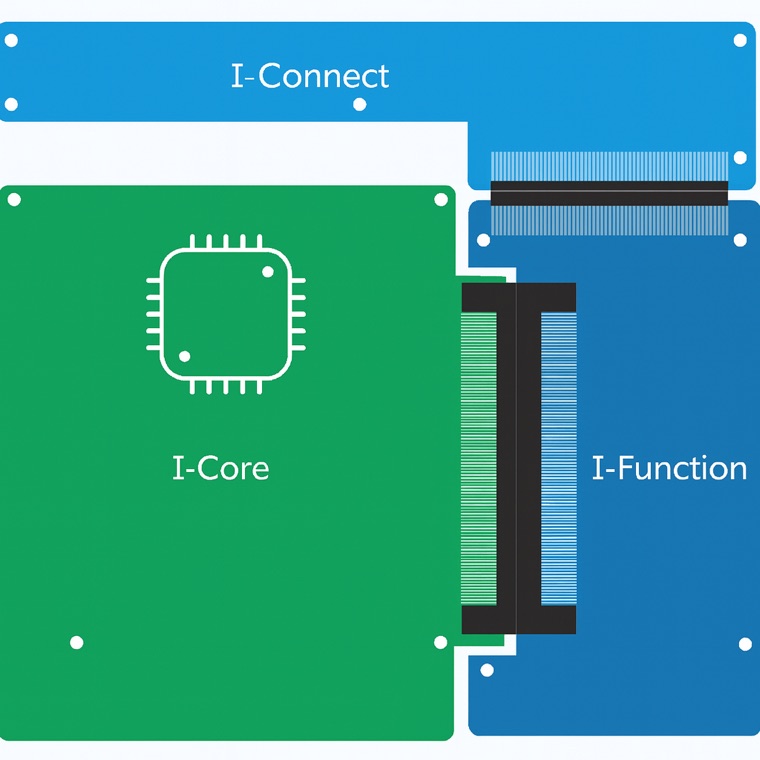
Based on the design concept of LEGO bricks: the core motherboard is decoupled from the function boards, and a growing ecosystem library supplies plug-and-play modules for different industries.
- Modular architecture — core board and function boards are decoupled, so a chassis is reconfigured instead of replaced.
- Custom combinations — dozens of communication, control, power and expansion modules are plug-and-play.
- i-Core / i-Function / i-Connect — compute, function and connection boards joined by board-to-board connectors.
- Six computing platforms and PCIe, USB, COM and Modbus on the same framework, with small-batch customization to control cost.

EdgeSync™
Acquisition path + control path + communication path + task engine
Edge-native intelligent execution inside a single device: acquisition, control, HMI, gateway functions, AI inference, communication and task scheduling in one coherent operational system.
- Acquisition — sensors, fieldbuses and industrial protocols managed in one place.
- Control — local control logic, real-time response and safety interlocks.
- HMI and gateway — a local operator interface, plus a path from the edge to the cloud or control room.
- AI and task execution — local inference, and the input → processing → output loop inside the device.

SafeCore™
Power protection, backup power, start–stop control, autonomous recovery
A system-level operational safety architecture built for harsh industrial environments — power outages, surges, grid fluctuations, power switching and unexpected shutdowns.
- Hardware-level power-on auto-start — no button press, unaffected by system crashes or BIOS resets; made for enclosed cabinets, screenless rack systems, unmanned lines and remote sites.
- Redundant power backup — a single power failure still allows continuous operation, and edge or vision servers do not restart.
- Software-level power-off protection — safe disk writes, so a power loss does not damage the system image and the device resumes its working state after restart.
- Intelligent lithium battery supply — backup buffering for the moment the power drops.
How they fit together
Physical, runtime, resilience
Top to bottom they describe a stack: the boards a machine is built from, the runtime that decides inside it, and the protection that outlasts a power event.
01
BlockCore™ — the physical layer
What the machine is built from: unified interfaces, mechanical structures and power delivery standards, assembled from boards instead of redesigned from scratch.
02
EdgeSync™ — the runtime layer
What happens inside the device: acquire, decide, actuate, display and forward — the input → processing → output loop stays on the machine.
03
SafeCore™ — the resilience layer
What keeps it running: auto-start when power returns, backup power through a failure, and safe writes so the system image survives.
Collectively, these technologies endow industrial equipment with executable, collaborative and sustainable operational capabilities — the sentence the whole architecture is built to deliver.
Which layer does your project need?
Tell us what the machine has to survive and what it has to connect to. We will say which layer carries the weight, and quote the configuration — or write to sales@cesipc.com.