



Pip: Machine vision is one of those fields where the camera gets all the credit and the industrial PC quietly holds everything together — until it doesn’t.
Mara: That’s the territory CESIPC-Summer covers in this episode: what machine vision actually demands from a computing platform, and how to match the hardware to the deployment.
Pip: Let’s start with the selection guide itself — inline inspection, AOI servers, and where the two platforms diverge.
Industrial PC for Machine Vision: Picking the Right Platform
Mara: The core tension here is that most people spec the camera and optics carefully, then treat the PC as an afterthought — and the guide opens by naming exactly what breaks when that happens.
Pip: The post puts it plainly: “A CPU that throttles under sustained load introduces timing inconsistency that no algorithm can compensate for.”
Mara: That’s the crux. Inspection algorithms run on every part, every cycle. If the processor can’t sustain its clock speed, the latency becomes variable — and at the edge of a detection threshold, variable latency means missed defects.
Pip: And it’s not just CPU thermals. The guide flags RAM and network architecture as equally consequential — a four-camera five-megapixel system at thirty frames per second generates over 1.8 gigabytes of raw image data per second, so buffer overflow isn’t theoretical.
Mara: Right, and the network point is specific: GigE Vision cameras stream 125 megabytes per second per port continuously. Sharing multiple cameras through one LAN port creates congestion and drops frames. Each camera needs its own independent channel.
Pip: Which is exactly what the EPC-309E is built around — four independent Intel Gigabit LAN ports on a compact fanless chassis, so a four-camera inline inspection array connects directly with no external switch in the path.
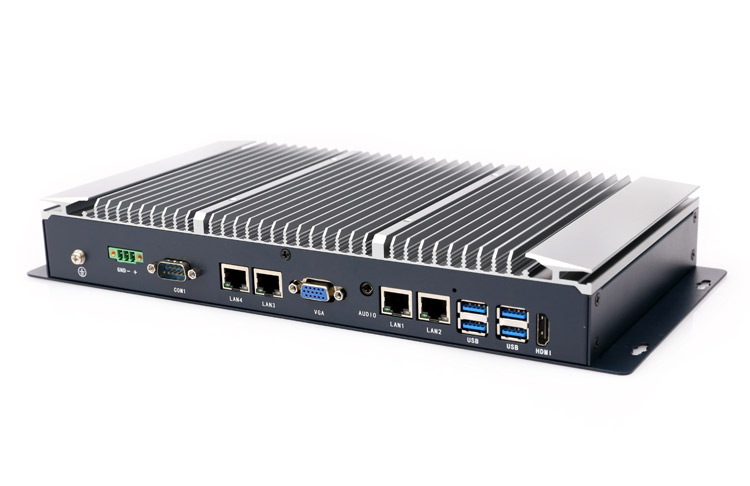
Mara: That makes it the right fit for space-constrained machine cabinets doing CPU-based work: blob analysis, edge detection, solder joint inspection, label verification. The BlockCore modular I/O handles trigger signals and PLC communication without chassis modification.
Pip: The IPC-627 is the other answer — and it exists for when the algorithm outgrows the CPU.
Mara: Exactly. The IPC-627 accepts Micro ATX industrial motherboards and provides a PCIe x16 slot for GPU cards or specialized frame grabbers — CoaXPress, Camera Link — that handle bandwidth beyond what GigE Vision supports. That’s the platform for deep learning inference, 3D point cloud processing, and centralized AOI servers.

Pip: So the decision really does come down to two questions: do you need PCIe expansion, and how tight is cabinet space?
Mara: The guide frames it that way directly. No GPU or frame grabber needed, space is constrained: EPC-309E. GPU acceleration or specialized expansion required: IPC-627. The operating envelope matters too — the IPC-627 chassis is rated for ten-G shock and zero to sixty degrees Celsius.
Pip: Industrial-grade ambiguity, resolved by asking the right questions first.
Mara: That’s the whole argument — start with what the system is actually asking of the hardware, then map to the platform.
Pip: Platform before camera. It’s a simple reframe, but it changes the whole spec process.
Mara: Next time, we’ll look at where else that logic applies across the industrial edge. Stay with us.
Talk to a CESIPC Engineer
Our application engineers are ready to help you select the right configuration, discuss ODM requirements, or provide a tailored quotation for your project.
Typical response within 24 hours · Multilingual support · CE / FCC / BIS compliant


