
Pip: Semiconductor etching happens at the micron scale, where a single stray particle or a microsecond of timing drift can turn a wafer into expensive scrap. The control hardware holding all of that together had better be serious.
Mara: CESIPC-Summer has been writing about exactly that — why fanless industrial PCs belong at the center of etching machine control, and what the architecture actually delivers. Let’s start with the case for going fanless in semiconductor environments.
Why Fanless PCs Belong Inside Etching Machines
Pip: The question this post is really asking is: why does the choice of cooling architecture matter at all when you’re controlling a plasma etcher? The answer turns out to be more consequential than it first sounds.
Mara: The post frames it directly — “Thermal fluctuation in computing hardware introduces CPU throttling, timing drift and data acquisition latency — unacceptable for plasma etching. The EPC-10XA with fanless design delivers stable performance across fluctuating thermal conditions.”
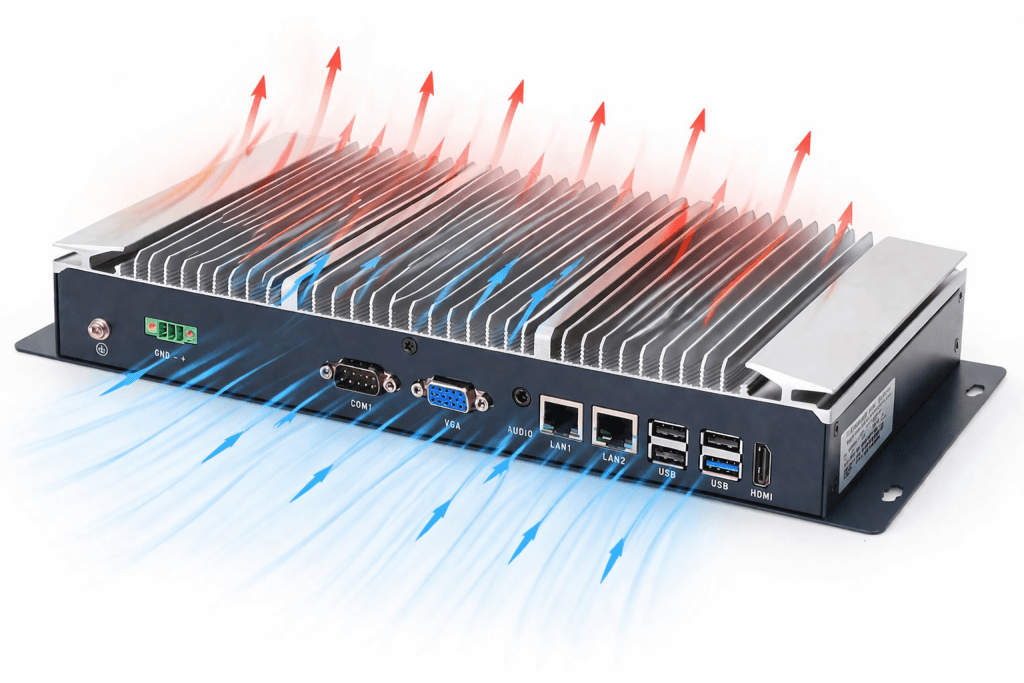
Pip: So the upshot is: a fan isn’t just a mechanical inconvenience in a cleanroom — it’s a vector for contamination and a source of the exact thermal instability that breaks process repeatability. Removing it is an engineering decision, not a cost-cutting one.
Mara: The post spells out three distinct failure modes that fan-cooled hardware introduces. Fans pull airborne particles, reactive gases, and conductive dust into the chassis. They create vibration and wear. And conventional PCs lack the power-loss recovery that etching recipes depend on — an unexpected reboot can scrap a wafer mid-process and force chamber recalibration.
Pip: That last one is the one that keeps OEM engineers up at night. A computer reboot is a recoverable IT event; a ruined wafer batch is a production event with a very different price tag.
Mara: The EPC-10XA addresses the uptime side with SafeCore power-loss protection and auto-restart recovery, and the connectivity side with three COM ports for mass flow controllers and vacuum controllers, dual Intel I210 Gigabit LAN for deterministic Ethernet, and a 9 to 36 volt wide DC input that handles cabinet power fluctuations without additional adaptation hardware.
Mara: The post also makes a lifecycle argument that matters specifically to equipment OEMs — semiconductor tools stay in production for seven to fifteen years, and consumer-grade PCs create redesign and recertification risk. The EPC-10XA’s long-lifecycle supply commitment is positioned as part of the value, not a footnote.
Pip: Decades of availability for hardware running inside a machine that itself runs for decades. The industrial PC outlasts the IT refresh cycle by design.
Mara: And TPM 2.0 rounds it out — hardware-based secure boot protecting recipe files and MES communication in smart fab environments where unauthorized recipe access is a real operational risk.
Pip: Contamination, timing, uptime, security, longevity — it’s a surprisingly complete argument for what is, at its core, a box with no moving parts.
Mara: The through-line here is that the control platform is where process reliability either holds or breaks down — and that choice has consequences measured in yield, not just uptime.
Pip: Next time, we’ll see what other corners of industrial computing CESIPC-Summer turns up. There’s always another environment where a fan is the wrong answer.
Talk to a CESIPC Engineer
Our application engineers are ready to help you select the right configuration, discuss ODM requirements, or provide a tailored quotation for your project.
Typical response within 24 hours · Multilingual support · CE / FCC / BIS compliant

