
Pip: There is a category of device that gets described as “rugged” right up until the moment someone actually drops it onto a concrete switchgear floor, and then it becomes a very expensive paperweight.
Mara: That’s the exact gap CESIPC-Summer’s recent writing addresses — what field hardware actually needs to survive in power utility environments, and how the right specs translate into real workflow changes for inspection teams.
Pip: Let’s start with what it takes to keep a tablet running through a full substation patrol shift.
Rugged Tablets on the Power Grid
Mara: The core question here is what “rugged enough for power utility work” actually means — not as a marketing claim, but as a set of specific, non-negotiable requirements that consumer and early industrial hardware have consistently failed to meet in the field.
Pip: A substation patrol technician at a 220kV switching station put it directly: “We were using a regular commercial tablet for recording inspection data. The third time it crashed mid-shift from vibration, we started thinking differently about what ‘mobile device’ actually means in this environment.”
Mara: What that means in practice is four concrete demands: always-on 4G LTE connectivity to push inspection records in real time, GPS with Beidou support for proof-of-presence at specific equipment locations, drop and shock tolerance rated to 1.2 metres, and native serial port access for relay protection units and legacy RTUs that still communicate over RS232.
Pip: That last one is the one that gets quietly skipped — and then a technician shows up on-site and discovers they cannot actually connect to the equipment they came to diagnose.
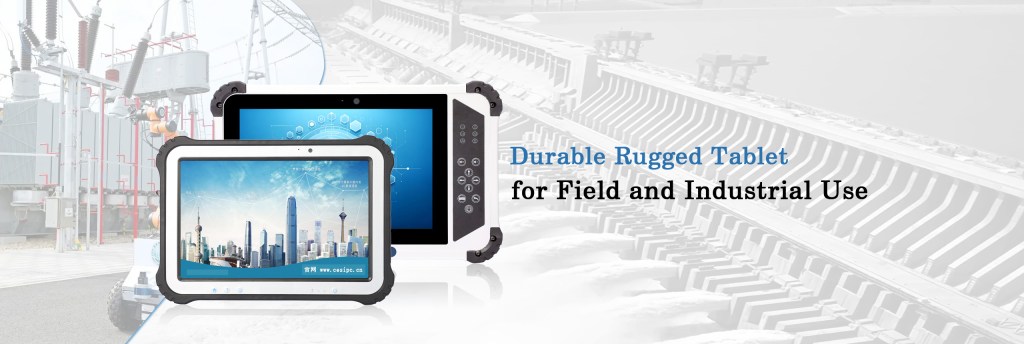
Mara: The TPC-1082A addresses all four requirements in a single 1.5kg device. It integrates 4G LTE, Wi-Fi 802.11ac, Bluetooth, and GPS with Beidou and GLONASS directly on the board. The front panel carries IP65 protection, the chassis handles 10g mechanical shock and continuous vibration to 200Hz, and the MTBF is rated at 50,000 hours.
Pip: Which is the kind of number that sounds abstract until you calculate how many eight-hour shifts it represents across a transmission line patrol team.
Mara: The post walks through three specific field scenarios: routine patrol at a 110kV or 220kV substation, on-site fault diagnosis where technicians need to pull relay event logs, cross-reference drawings, and close work tickets simultaneously, and transmission line tower inspection on 500kV corridors where there is no fixed network and the hardware is outdoors for a full shift.
Pip: In each case the argument is the same — it is not one feature that changes the workflow, it is the combination arriving without integration work, running standard Windows 10 out of the box.
Mara: The RS232 port connecting directly to relay protection units without a USB adapter is a small detail that removes a real failure point from every fault diagnosis callout.
Pip: Consumer assumptions about what a “mobile device” means keep colliding with environments that were never part of the design brief.
Mara: And the gap between those assumptions and what substations and transmission corridors actually demand is exactly where the next wave of field hardware decisions gets made.
Talk to a CESIPC Engineer
Our application engineers are ready to help you select the right configuration, discuss ODM requirements, or provide a tailored quotation for your project.
Typical response within 24 hours · Multilingual support · CE / FCC / BIS compliant

