
Pip: Industrial cameras are everywhere on the factory floor — inspecting, measuring, guiding robots. But a camera without a brain is just an expensive lens pointed at a conveyor belt.
Mara: That’s exactly the gap CESIPC1’s recent writing addresses — what sits between the camera and the decision, why that hardware is so often underspecified, and what the consequences look like in a real production environment. Let’s start with the machine vision PC itself.
What Powers a Vision System? The PC Behind the Camera
Pip: The central tension here is one most engineers don’t think about until something breaks: the camera gets all the attention, but the computing platform is where inspections actually succeed or fail.
Mara: The post frames it plainly — the system maps to a human analogy: “The camera is the eyes, the Machine Vision PC is the brain, and the PLC or robot is the hands.” Without the vision controller, cameras just collect pictures — they cannot inspect, measure, or guide.
Pip: That distinction matters because it reframes where to invest. If the brain is underpowered or poorly designed, the eyes are wasted — and that’s not a camera problem, it’s a platform problem.
Mara: And the post identifies hardware limitations as the number one source of system instability in real-world deployments. Three failure modes get the most attention: network bottlenecks from inadequate Ethernet controllers, USB bandwidth contention across shared controllers, and thermal throttling on hardware not rated for continuous duty.
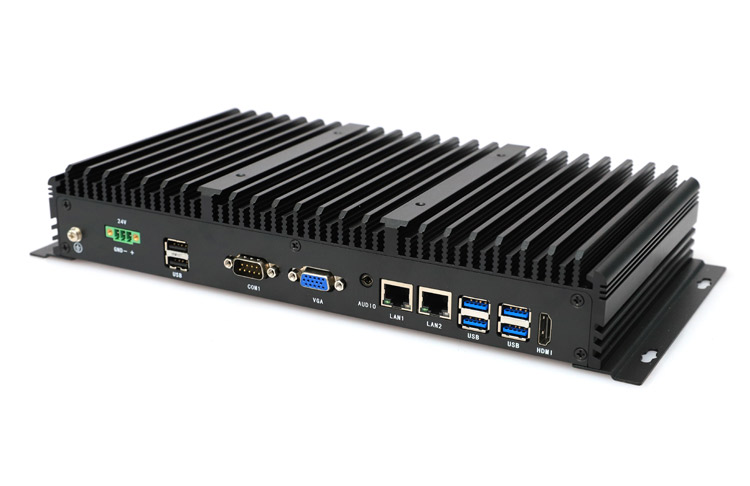
Pip: The USB issue is the one that catches people — more ports sounds like more capability, until four cameras share one controller and frames start dropping.
Mara: Right. The post is specific: many industrial PCs share a single USB controller across multiple ports, which causes bandwidth contention when connecting several high-resolution cameras simultaneously. The engineering answer is independent channel design — dedicated bandwidth per camera, not pooled bandwidth across a hub.
Mara: The post also includes a verified deployment figure: eighty UPC-302D units running four five-megapixel GigE cameras each, over eighteen months of continuous operation, with zero hardware-related failures attributed to the independent USB architecture.
Pip: Eighty units, eighteen months, zero failures — that’s the kind of number that ends a procurement debate.
Mara: On the thermal side, the argument is straightforward: production lines run around the clock, office-grade hardware throttles under sustained load, and fanless sealed chassis designs eliminate both dust intake and fan failure as failure modes. Wide-temperature SKUs extend the operating envelope to conditions most office hardware never sees.
Pip: So the checklist the post provides — independent USB controllers, dual Intel Gigabit LAN for network isolation, fanless wide-temperature design, industrial SSD, wide voltage input — isn’t a feature sheet, it’s a failure-prevention list.
Mara: Exactly, and the post closes by positioning the vision PC not as a supporting component but as the core processing engine behind intelligent manufacturing, with AI-powered defect detection and edge visual processing increasing the throughput demands on that platform going forward.
Pip: The throughput demands only go up from here — more cameras, higher resolution, more AI inference at the edge.
Mara: Which means the platform choice made today has to carry the load of tomorrow’s inspection requirements. Worth thinking about before the next deployment.
Talk to a CESIPC Engineer
Our application engineers are ready to help you select the right configuration, discuss ODM requirements, or provide a tailored quotation for your project.
Typical response within 24 hours · Multilingual support · CE / FCC / BIS compliant

