
RFID industrial panel PC · 15″ 4:3 · 13.56 MHz reader · IC / ID cards · IP65
UTC-S1562C 15-inch RFID Panel PC with the Card Reader Built into the Panel
15″ 1024 × 768 · IP65 front · 2× Intel LAN · 5.0 kg
The reader is inside the panel, and the screen is 15 inches. The UTC-S1562C pairs a 13.56 MHz reader for IC and ID cards with a 15-inch 1024 × 768 4:3 display, so a workstation can show the login, the work order, the parts list and the machine state at the same time. Cards report over RS232 or USB, the front is IP65, and the documented build is Celeron J1900 — with J6412, 10th Gen and 12th Gen Core boards available on the same chassis.

13.56 MHz readerIC / ID cards0~60 mm read distance15″ 1024 × 768Celeron J1900IP65 front
17+
Years
50+
Countries
1
MOQ unit
2–4
Weeks lead
OEM
ODM & branding
At a glance
UTC-S1562C key specifications
The panel, the touchscreen, the compute, the ports and the mechanical fit — everything that decides whether this panel drops into your cutout.
Panel size
15″ 4:3
Resolution
1024 × 768
Brightness
300 cd/m² · 500 : 1
Touch
Capacitive (10-point)
Processor
Celeron J1900
Memory
4~8GB DDR3L
Storage
mSATA SSD
Serial
4× RS232 + 2× RS485 (DB9)
USB
5× USB 2.0 + 1× USB 3.0
Ethernet
2× Intel I210 Gigabit LAN
Display
HDMI + VGA (dual display)
Protection
IP65 front
Design notes
Why the reader lives inside the panel
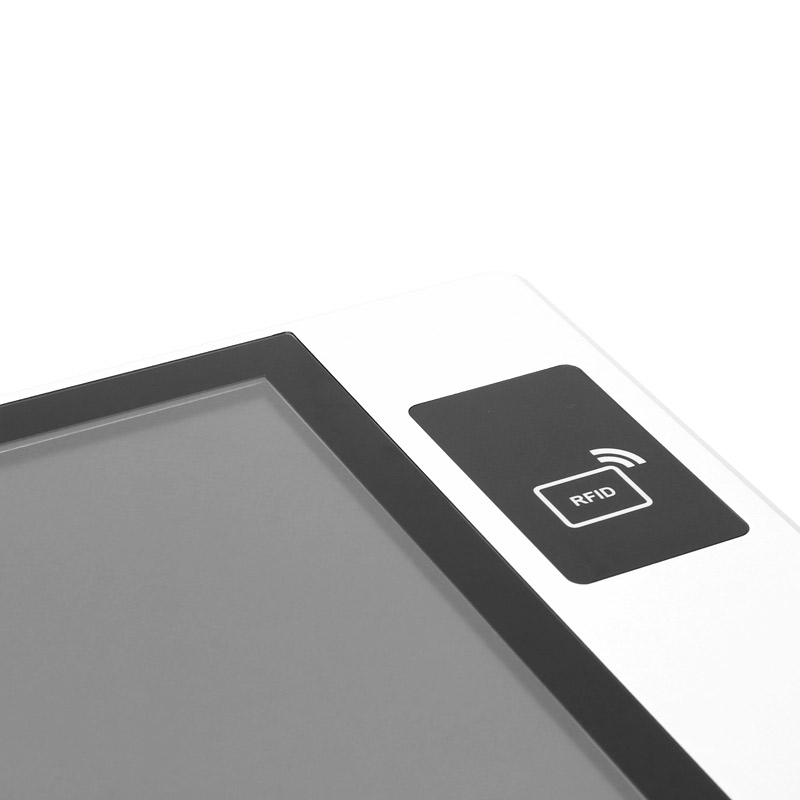
15 inches of 4:3 screen for a badge-and-work-order station
The UTC-S1562C puts a 15-inch 4:3 TFT at 1024 × 768 behind the IP65 front — 300 cd/m² at 500:1 with a 50,000-hour LED backlight. The 4:3 shape is the point: a login prompt, a work order, a parts list and live machine state stack up vertically, and on a 4:3 screen they all stay visible at once instead of being pushed off the side. Touch is projected-capacitive as standard, with resistive 5-wire available for gloved operation.
- 1024 × 768 on a 15-inch 4:3 panel, 300 cd/m², 500:1
- Projected capacitive touch; resistive 5-wire optional
- IP65 front — wiped down without shutting the line
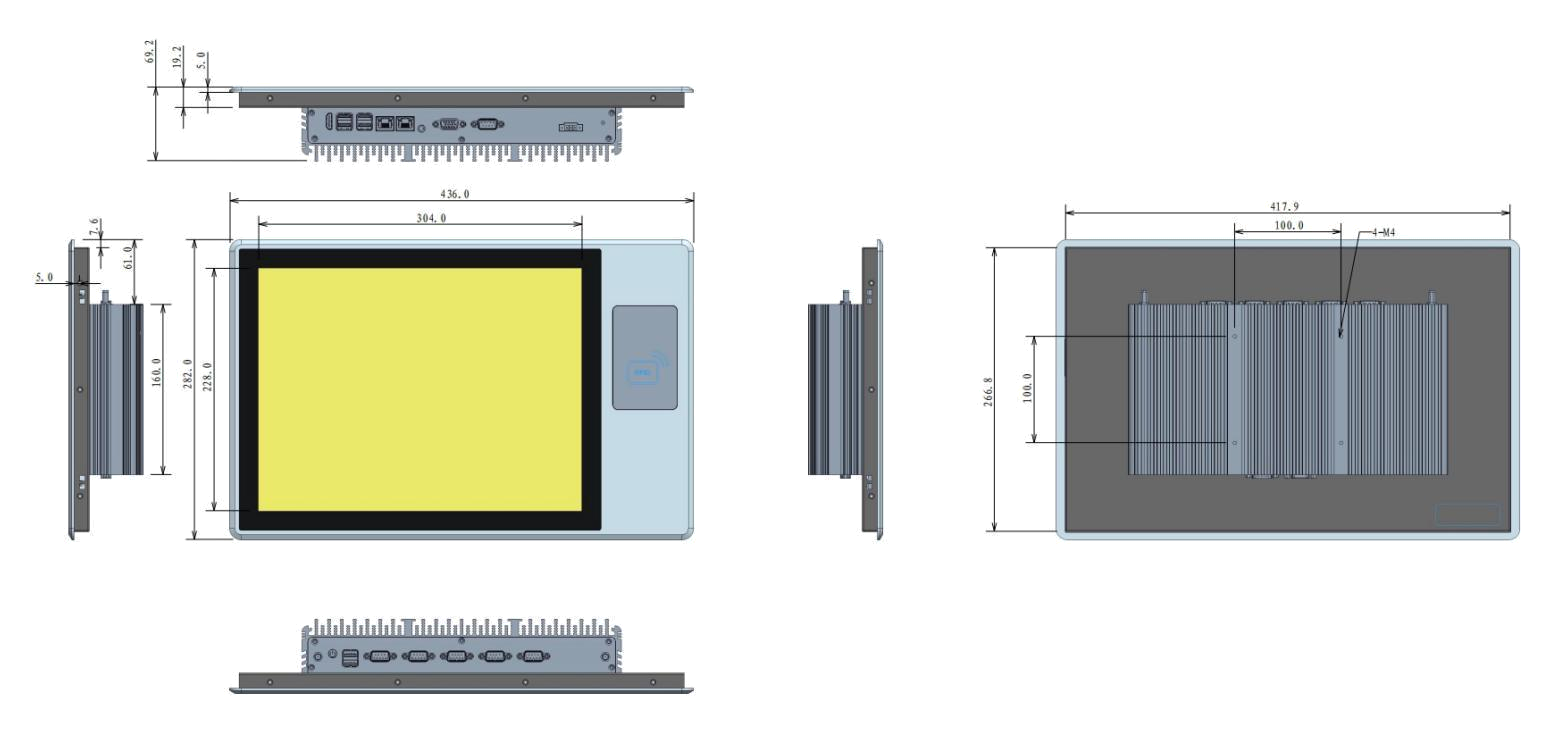
- 436.0 × 282.0 × 69.2 mm, cutout 417.9 × 266.8 mm, 5.0 kg
- Fanless — no filter to clog in a dusty hall
The reader is inside the panel, not a box on the machine
A conventional station is a panel PC plus a reader: second enclosure, second power adapter, a cable between them and a second thing to mount. The UTC-S1562C has the 13.56 MHz reader in the same enclosure as the HMI — one cutout, one power feed, one device — reading IC cards as standard with ID cards optional at 0~60 mm. It reports over RS232 (read straight from the serial buffer by a PLC, no OS involved) or over USB, where the card ID types into whatever field has focus.
- 13.56 MHz, IC card standard / ID card optional
- 0~60 mm reading distance, 3.3V~5V (standard 5V)
- RS232 for PLC integration — no driver, no operating system
- USB — the reader types the ID into the focused field
- No second enclosure, cable or power supply on the machine

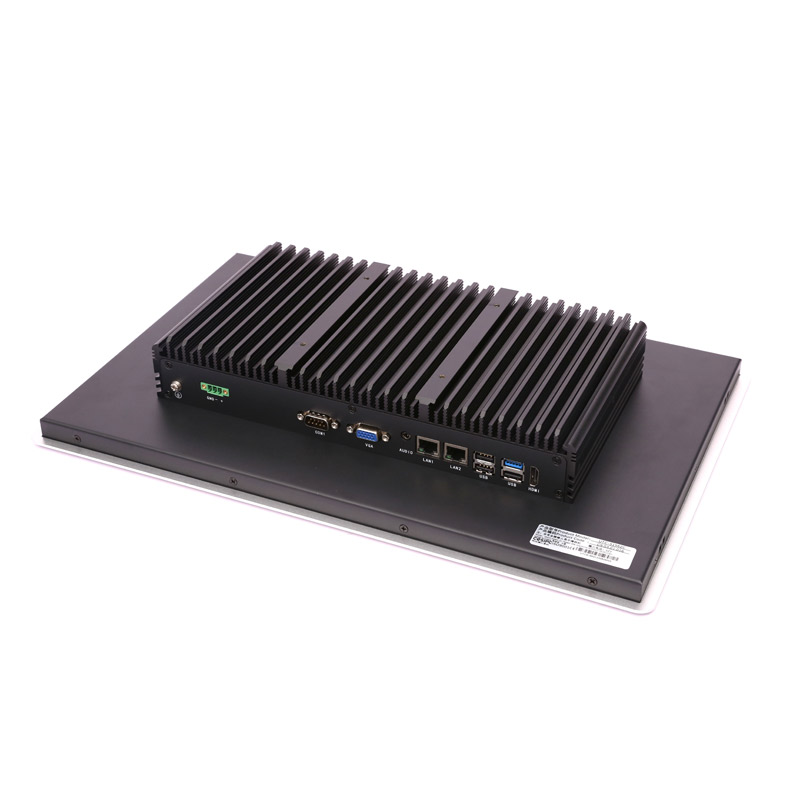
One chassis, four compute boards — swap the board, keep the panel
The UTC-S1562C ships with the documented Celeron J1900 build: 4 cores at 2.0~2.42 GHz, 10W TDP, 4~8GB DDR3L and a full-size mSATA SSD. Because it is built on BlockCore™, the same enclosure, touchscreen, RFID reader and cutout also take Celeron J6412, 10th Gen and 12th Gen Core boards — those are ordered as UTC-S1572C / S1592C / S1522C. Standard I/O is 4× RS232, 2× RS485 (RS422 optional), 5× USB 2.0, 1× USB 3.0, HDMI + VGA and dual Intel I210 LAN.
- Celeron J1900, 4 cores, 10W — 4~8GB DDR3L, mSATA SSD
- BlockCore™: same panel, reader and cutout on every compute board
- 4× RS232 + 2× RS485 (RS422 optional), 2× Intel I210 Gigabit LAN
- HDMI + VGA dual display, audio, i-Function slot for 5G / CAN / DIO
- LEGO MODE board-to-board design with i-Door service access
Configurations
Choose the UTC-S1562C configuration
One factory build, on one panel. The display, the touchscreen, the RFID reader, the ports and the cutout are fixed by the configuration; the same chassis is also built with other compute boards, quoted per project.
Celeron J1900
Standard build · Celeron J1900
Best forBadge-in workstations that run the operator HMI and hand the card ID to the MES — the documented factory build, on a 15-inch 4:3 screen. The same chassis is also built with Celeron J6412, 10th Gen and 12th Gen Core boards (UTC-S1572C / S1592C / S1522C) where more compute is needed.
Part number C11.01.04.042 — standard build: 4GB DDR3L memory, mSATA SSD 128GB.
System core
| Processor | Celeron J1900 |
| Memory | 4GB DDR3L (DDR3L, 4~8GB) |
| Storage | mSATA SSD 128GB |
| Storage slots | 1× full-size mSATA SSD |
| Cooling | Fanless — no fan, no filter |
| Operating system | Windows 10 / 11 (Windows 7 on the J1900 build) · Linux Ubuntu 16.04 / 18.04 / 20.04 / 22.04 |
Panel & touch
| Panel size | 15-inch TFT LCD, 4:3 |
| Max. resolution | 1024 × 768 |
| Brightness | 300 cd/m² |
| Contrast | 500 : 1 |
| Backlight | LED, 50,000 hours |
| Touch panel | Projected capacitive touch (resistive 5-wire optional) |
| Front protection | Front panel IP65 |
RFID identification
| Card types | IC card standard (ID card optional) |
| Working frequency | 13.56 MHz |
| Reading distance | 0~60 mm |
| Interface | RS232 (direct PLC / controller integration) and USB (driver-free) |
| Operating voltage | 3.3V~5V, standard 5V |
I/O & networking
| USB 2.0 | 5× USB 2.0 (Type-A) |
| USB 3.0 | 1× USB 3.0 (Type-A) |
| COM | 4× RS232 + 2× RS485 (DB9), RS422 optional |
| Display | 1× HDMI + 1× VGA (dual display) |
| Audio | 1× audio, 3.5 mm TRRS |
| Ethernet | 2× Intel I210 Gigabit LAN |
Expansion & wireless
| Wireless network | 4G LTE full netcom module (optional) |
| Wi-Fi | Intel N6235 300 Mbps, 802.11a/b/g/n, 2.4G / 5G |
| i-Function slot | BlockCore™ modular slot — 5G, multi-LAN, CAN, DIO |
Power
| DC input | 1× 3-pin pluggable terminal block, 12V DC (9~36V DC optional) |
| Power button | 1× ATX power on/off button |
| Booting | 1× AT/ATX mode switch (internal settings) |
Environmental
| Operating temperature | 0~50℃ (-40~70℃ optional) |
| Storage temperature | -10~60℃ |
| Relative humidity | 10%~90%, non-condensing |
| EMC | CE, FCC (EN 55032 & EN 55035), EN IEC 61000-3-2 |
| Factory | ISO 9001:2015 |
| MTBF | 60,000 hours |
Mechanical & compliance
| Dimension | 436.0 (W) × 282.0 (H) × 69.2 (D) mm |
| Cutout size | 417.9 × 266.8 mm |
| Weight | 5.0 KG N.W. |
| Material | 6063 high-strength aluminium alloy |
| Construction | Aluminium extrusion + sheet metal structure |
| Mounting | Wall mount / VESA mount |
| Certifications | CE / FCC, according to EN 55032 & EN 55035 |
| ODM | BIOS / Boot on LOGO / OEM |
Drawings
Dimensions, cutout and I/O layout
Check the cutout against your cabinet door before ordering — the UTC-S1562C needs 417.9 × 266.8 mm and 69.2 mm of depth behind it.

Ordering information
Configurations and part numbers
Each row is a factory build: the build fixes the processor, the memory and the storage. The panel, the touchscreen, the I/O and the cutout are the same for every row.
| NO. | Model | Product Part Number | Description | Standard Memory | Standard Storage |
|---|---|---|---|---|---|
| 1 | UTC-S1562C | C11.01.04.042 | Celeron J1900 Processor | 4GB DDR3L | mSATA SSD 128GB |
Contact sales for volume pricing, memory and storage upgrades, the −40–70 ℃ extended temperature build, and 4G / Wi-Fi configuration on the same panel.
Downloads
UTC-S1562C downloads
The full specification is available immediately. Manuals, drivers, certificates and drawings are issued with the quotation.
UTC-S1562C datasheet
Panel, touch, I/O, dimensions, cutout and the ordering table (PDF).
Panel PC buying guide
How to size the display, choose the protection rating and specify the cutout.
Industrial PC FAQ
Processor, operating system, mounting and environmental questions.
Manual, drivers & certificates
User manual, driver pack, CE / FCC / BIS certificates, 2D and 3D drawings — issued per order.
FAQ
UTC-S1562C frequently asked questions
Questions about the built-in 13.56 MHz reader and its card types, RS232 versus USB, how the 15-inch model compares with the 10-inch one, the Celeron J1900 build and the BlockCore™ compute options, and the cutout and mounting.
Why choose a 15-inch RFID panel PC rather than the 10-inch model?
Screen area for stacked information. A badge-in station shows an operator prompt, a work order, a parts or process list and live machine state at once; on the 15-inch 1024 × 768 4:3 panel all of that fits without scrolling or switching pages, while the 10-inch UTC-S1062C suits single-purpose stations. Both use the same 13.56 MHz reader, the same card types and the same RS232 / USB interfaces, so the choice is about the panel size and the cutout, not about functionality.
Why integrated RFID instead of a panel PC plus a separate reader?
Because the separate reader brings its own enclosure, power adapter and a cable between the two devices. The UTC-S1562C has the reader inside the panel: one cutout, one power feed, one device to install and support. Across a line of workstations that is the difference between one installation per station and two — and it removes the cable that usually fails first in a production hall.
What cards does the built-in reader read, and at what distance?
It reads IC cards as standard, with ID cards optional, at 13.56 MHz and a typical reading distance of 0~60 mm, powered at 3.3V~5V (standard 5V). Tell us which badge the site already issues and the reader is configured for it at the factory.
Should I use the RS232 or the USB interface?
They read the same cards at the same distance and differ in how the ID reaches your software. RS232 suits a PLC or embedded controller reading tag data straight from the serial buffer — no operating system, no driver. USB suits Windows or Linux applications: the reader behaves as a keyboard, so the ID is typed into whichever field has focus without installing anything, which is why many MES integrations use it.
Where do 15-inch RFID stations get installed?
Stations where a person is identified before work starts: operator authentication and access control with role-based permissions, work-order verification before a batch runs, production traceability for food and pharmaceutical audits, workpiece identification in discrete and garment manufacturing, and MES data collection points at incoming inspection, assembly, QC and packing.
What processors and performance options are available?
The UTC-S1562C itself is the documented Celeron J1900 build: 4 cores at 2.0~2.42 GHz, 10W TDP, 4~8GB DDR3L and a full-size mSATA SSD (4GB / 128GB as standard). The same chassis is also built with Celeron J6412 (UTC-S1572C), 10th Gen Core i3/i5/i7 (UTC-S1592C) and 12th Gen Core i3-1215U / i5-1235U / i7-1250U (UTC-S1522C) — separate part numbers, identical panel, reader and cutout.
What is BlockCore™, and how does it help an RFID deployment?
It is the modular architecture that separates the compute board from the RFID-enabled display assembly. A CPU change is a board swap — the reader, the 15-inch touchscreen, the sealed connectors and the cutout stay exactly as they are. It also means the same compute board is used across standard (non-RFID) panel PCs, so a mixed fleet shares one spare-part number.
What happens to the panel if power is cut mid-shift?
SafeCore™ guards the operating system against file corruption when power is cut abruptly — shift-change shutdowns and lockout/tagout are the usual causes. Combined with auto power-on after power recovery, the workstation comes back by itself, so the authentication records and the traceability log survive the interruption.
Is the RFID reader protected by the IP65 front?
Yes — the reader sits behind the same IP65 front panel as the display, so the whole face can be wiped down and there is no separate reader window to seal. Touch is projected-capacitive with up to 10 points, or resistive 5-wire where operators work in gloves.
What are the panel dimensions, cutout and mounting options?
The chassis measures 436.0 (W) × 282.0 (H) × 69.2 (D) mm with a cutout of 417.9 × 266.8 mm, weighs 5.0 kg N.W., and is built from 6063 high-strength aluminium alloy extrusion with a sheet-metal structure. It mounts in the panel cutout, on a wall bracket or on a VESA mount; cooling is fanless; power is a 3-pin pluggable terminal at 12V DC with 9~36V DC available.
What I/O does the panel carry?
4× RS232 and 2× RS485 on DB9 (RS422 optional), 5× USB 2.0 and 1× USB 3.0, HDMI + VGA dual display, one 3.5 mm TRRS audio jack and 2× Intel I210 Gigabit LAN. Wi-Fi is an Intel N6235 module (802.11a/b/g/n, 2.4G / 5G), 4G LTE is optional, and the BlockCore™ i-Function slot takes 5G, extra LAN, CAN or DIO modules.
Which OS images ship, and what certifications apply?
Windows 10 and Windows 11 (the J1900 build can also run Windows 7), or Linux Ubuntu 16.04 / 18.04 / 20.04 / 22.04. EMC is CE and FCC to EN 55032 and EN 55035 plus EN IEC 61000-3-2, the factory is ISO 9001:2015 and MTBF is 60,000 hours.
What can be customised on the UTC-S1562C?
Yes — it is a BlockCore™ ODM platform. Card type (IC standard, ID optional), reader interface (RS232 or USB), BIOS configuration, booting on your own LOGO and OEM branding are all set per project, and the i-Function slot takes the extra modules a deployment needs. Fingerprint or face recognition can be added alongside the reader where multi-factor authentication is required.
Related models
Other models in the ODM range
The UTC-S1562C is the 15-inch member of the RFID range, with the same reader as the 10-inch UTC-S1062C on a 4:3 screen that carries more of the work order at once. If the station is a sewing or garment bench, the EPC-S15-RFID is the purpose-built variant for that; the UTC-S2162C puts the reader behind a 21.5-inch screen and the UTC-W2172C adds DIY function keys.
Send us the cutout, the I/O list and the environment
Tell us the panel size and the existing cutout, the networks and serial devices you have to connect, the processor tier and the environment. We will confirm the configuration, the part number, the lead time and the price — typically the same working day.
Request a quotation
Tell us what you need — we will quote your application
Pick the specification and the application below — every answer reaches us as a separate line, so one reply can confirm the exact build, lead time and price. Not sure about a field? Leave it on “advise me” and our engineers will choose for you.

