
Pip: Industrial PCs that live outdoors — not in a server room, not in a climate-controlled cabinet, but genuinely outside where the temperature swings and the dust settles wherever it likes.
Mara: CESIPC-Summer walks us through exactly that territory today — what it actually takes to put a computing platform inside an outdoor automation control cabinet and keep it running. Let’s start with the real-world application case.
Outdoor Industrial PC for Automation Control Systems
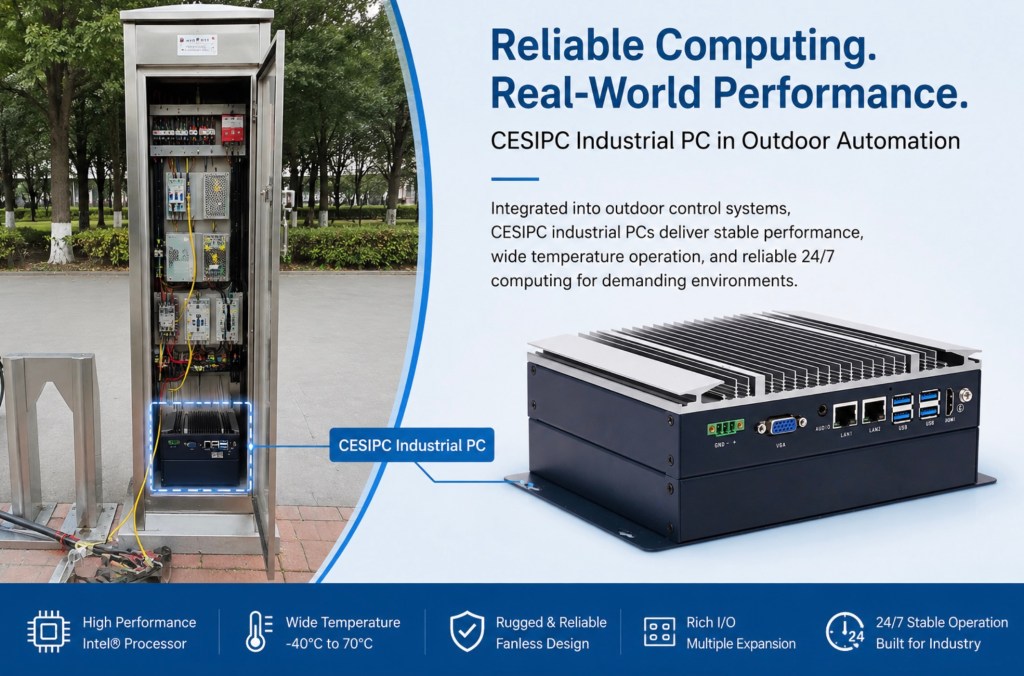
Pip: The central question here is what separates an industrial PC that belongs in an outdoor control cabinet from one that just technically fits inside one. The post argues it’s not about raw CPU performance — it’s about the complete system architecture.
Mara: The post frames it directly: “Choosing a computer based only on CPU performance is therefore not enough. The complete system architecture matters.”
Pip: That’s the crux of it. An outdoor automation system might face temperature swings, dust, power interruptions, and months between maintenance visits — none of which a benchmark score addresses.
Mara: The post walks through each of those challenges with the EPC-10XA as the working example. Fanless passive cooling via an aluminum enclosure means no fan bearing to wear out and no forced-air intake pulling dust through the chassis — both real concerns for unattended outdoor equipment.
Pip: And the power side is worth dwelling on. Industrial field installations don’t always hand you a clean, stable supply.
Mara: Right — the EPC-10XA supports a 9 to 36V DC wide-range input, covering common 12V and 24V DC architectures. It also includes automatic power-on after power recovery, so if supply is interrupted and restored, the system restarts without anyone pressing a button on-site.
Pip: That automatic restart detail is quietly important for anything running unattended in a remote location.
Mara: The post also covers SafeCore power-loss protection — system-level write protection combined with automatic recovery — to reduce file-system problems after unexpected shutdowns. On the connectivity side, the platform includes RS-232, RS-485, dual Gigabit Ethernet, USB, and optional 4G or 5G through BlockCore modular expansion.
Pip: So the integrator isn’t locked into one fixed configuration — they can match the I/O to whatever field devices the application actually uses.
Mara: Exactly. Temperature range is configurable too: standard operation runs 0°C to 50°C, with an extended-grade option reaching -40°C to 70°C. And the compact 229 by 160 by 47 millimeter form factor means it installs directly inside the cabinet alongside PLCs, power supplies, and I/O modules without demanding its own enclosure.
Pip: A machine that fits into the cabinet rather than demanding the cabinet fit around it — that’s the design philosophy in one sentence.
Mara: The through-line here is that outdoor automation asks questions a commercial PC was never designed to answer.
Pip: Fanless, wide-temperature, power-resilient, compact — the checklist is longer than it looks. More on what industrial hardware demands next time.
Talk to a CESIPC Engineer
Our application engineers are ready to help you select the right configuration, discuss ODM requirements, or provide a tailored quotation for your project.
Typical response within 24 hours · Multilingual support · CE / FCC / BIS compliant


We use your details only to answer this enquiry — no newsletters, no sharing. Drawings or a photo of the existing panel can be sent to sales@cesipc.com.