
Choosing an industrial panel PC involves more than selecting a display size or processor. In this episode, we discuss the key factors that affect panel PC selection, including computing performance, screen size, cooling design, IP protection, mounting and operating environment.
The goal is to help machine builders and industrial users match the hardware configuration to the actual application instead of simply choosing the highest available specifications.
What You’ll Learn in This Episode
- How to select the right display size for an industrial application
- When to choose fanless or active cooling
- How computing performance affects system design
- What IP rating is required for different environments
- Why mounting and operating conditions should be considered before selecting hardware
Pip: Industrial PCs are not glamorous. They sit inside cabinet doors and get hosed down with chemicals, and nobody writes songs about them — but somebody should probably read the manual.
Mara: That somebody is CESIPC-Summer, whose recent work covers exactly how to navigate the selection process for industrial panel PCs — display sizing, performance tiers, IP protection, mounting, and the environments that push all of it to the limit.
Pip: Let’s start with what it actually takes to pick the right one.
—
Choosing the Right Industrial Panel PC
Mara: The central question here is deceptively simple: how do you match a panel PC to its application without over-engineering it or leaving it underprotected? The post works through that systematically, from display to processor to housing.
Pip: The guiding principle the post lands on is worth quoting directly. On performance sizing, it says: “As much performance as necessary, but as little potential for failure as possible.”
Mara: That framing matters because higher performance means more heat, more power draw, and in enclosed installations like control cabinets, a real thermal management problem. A fanless, lower-power unit avoids moving parts and maintenance — but only if the workload actually fits.
Pip: And the workload categories are pretty concrete. Simple HMI visualization and status displays sit at the low end. Standard machine control and MES applications land in the middle. Video processing, vision systems, and edge computing push into high-performance territory — where active cooling becomes unavoidable.
Mara: Display selection gets the same structured treatment. Size affects resolution, and resolution has to match whatever the application is optimized for. The post notes that a mismatch “may result in a noticeable loss of application quality” — which, in a production environment, is not a minor nuisance.
Pip: Aspect ratio is the detail people skip and then regret. Classic 4:3 and 5:4 formats still dominate legacy industrial setups, but 16:9 widescreen is now standard across much of the portfolio, with 21:9 available for specific applications.
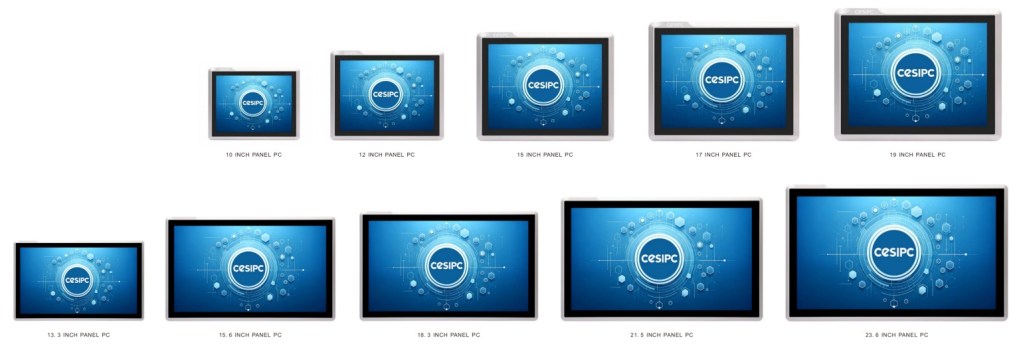
Mara: IP protection follows the same logic — match the environment, not the spec sheet ceiling. IP54 handles limited dust and splash. IP65 is dust-tight and jet-water resistant. For food, beverage, pharmaceutical, or chemical environments, IP67 and IP69K with stainless steel housings are the baseline, not the upgrade.
Pip: The waterproof panel PC angle is where this gets genuinely demanding — those are the conditions where the housing concept, the sealing, and the mounting method all have to be decided together, not separately.
Mara: Mounting options covered include flush mounting for control cabinets, VESA and swivel-arm configurations, rack mounting, open-frame integration, and wall-mounted housing for building automation. Each changes what IP rating is practically achievable and what the installation footprint looks like.
Pip: Outdoor use gets its own note — extended temperature ranges down to minus 40 degrees Celsius, and display brightness calibrated for direct sunlight readability without causing glare during night operation. The details, as the post puts it, determine success or failure.
Mara: The upshot is that no single spec wins the selection — it’s the combination of environment, workload, mounting, and protection class that points to the right unit. That’s the framework the post is built around.
Pip: Which means the real starting point is always the application, not the hardware catalog.
—
Mara: What holds all of this together is the idea that industrial hardware selection is an environmental problem as much as a performance problem.
Pip: Right — the spec that matters most is usually the one the installation site dictates. More on what those sites demand next time.
Talk to a CESIPC Engineer
Our application engineers are ready to help you select the right configuration, discuss ODM requirements, or provide a tailored quotation for your project.
Typical response within 24 hours · Multilingual support · CE / FCC / BIS compliant


We use your details only to answer this enquiry — no newsletters, no sharing. Drawings or a photo of the existing panel can be sent to sales@cesipc.com.