
An outdoor industrial PC must do more than provide computing power. It needs to operate reliably in changing temperatures, support industrial communication, fit inside a control cabinet, and continue running with minimal maintenance. In this real-world application, a CESIPC EPC-10XA Industrial PC is integrated into an outdoor automation control system, providing reliable computing and communication inside the equipment cabinet.
What Is an Outdoor Industrial PC?
An outdoor industrial PC is a ruggedized computer designed to provide computing, communication, monitoring, or control functions in equipment deployed outside conventional office or factory environments.
Unlike a commercial desktop PC, an industrial computer is designed around requirements such as continuous operation, industrial I/O, wide-range power input, fanless cooling, and long-term system stability.
Outdoor automation systems can be found in access control, smart infrastructure, energy monitoring, water treatment, transportation, remote equipment, and other unattended applications.
The computer may be installed inside a control cabinet, but its reliability directly affects the availability of the entire system.
The Challenge: Computing Inside Outdoor Automation Equipment
Outdoor automated equipment faces a different operating environment from a typical office computer.
Temperature fluctuations, dust, humidity, power variations, vibration, and limited access for maintenance can all affect system reliability.
For system integrators, the industrial computer therefore needs to address several key requirements:
- Stable 24/7 operation
- Reliable operation across changing temperatures
- Fanless cooling with no moving parts
- Multiple industrial communication interfaces
- Wide-range DC power input
- Compact installation inside control cabinets
- Protection against unexpected power loss
- Flexible connectivity for different automation devices
Choosing a computer based only on CPU performance is therefore not enough. The complete system architecture matters.
Real-World Application: CESIPC Industrial PC in an Outdoor Control Cabinet
The image below shows a real-world outdoor automation application in which a CESIPC industrial computer is integrated into an equipment control cabinet.
The exact end equipment can vary depending on the automation system, but the architecture illustrates a common industrial deployment: the industrial PC is installed inside the cabinet together with power supplies, electrical protection components, control modules, and field wiring.
In this configuration, the EPC-10XA functions as an embedded computing platform supporting system-level computing and communication.
Its compact form factor allows the computer to be installed directly inside the control cabinet rather than requiring a separate computer enclosure.
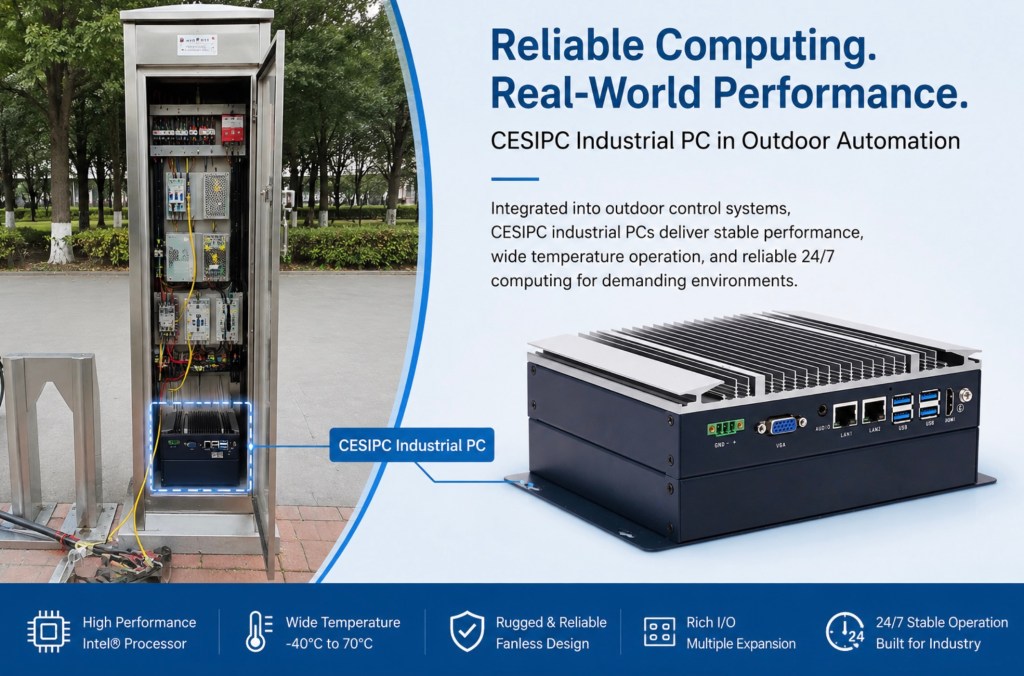
Real-world application: Outdoor automated equipment
Computer: CESIPC EPC-10XA Industrial PC
Installation: Inside an industrial control cabinet
Role: Industrial computing, communication, monitoring, and system control
Why a Fanless Industrial PC Is Suitable for Outdoor Automation
Cooling is one of the most important considerations when selecting an industrial computer.
The EPC-10XA uses a fanless passive cooling design. Instead of relying on a mechanical cooling fan, the industrial-grade aluminum enclosure is designed to dissipate heat without moving parts.
This design offers several practical advantages for automated equipment.
No Mechanical Fan Failure
A fanless computer has no cooling fan bearing that can wear out over time.
For equipment deployed in locations where maintenance access is limited, eliminating moving cooling components can simplify long-term maintenance.
Reduced Dust Intake
Traditional fan-cooled computers continuously draw air through the chassis. In dusty environments, this can increase the accumulation of particles inside the system.
A fanless architecture avoids this continuous forced-air intake.
Continuous Operation
The EPC-10XA is designed as a headless embedded industrial computer for installation inside control cabinets. It supports multiple processor configurations, from Intel Celeron to 10th and 12th Gen Intel Core processors.
This allows system integrators to select computing performance according to the workload instead of using one fixed configuration for every project.
Wide-Range Power Input for Industrial Systems
Outdoor automation equipment may not always operate with the same power conditions found in office environments.
The EPC-10XA supports a 9–36V DC wide-range power input, making it suitable for industrial systems using common 12V or 24V DC power architectures.
The system also supports automatic power-on after power recovery.
This is particularly useful for unattended equipment. If power is interrupted and subsequently restored, the computer can automatically restart without requiring an operator to physically press the power button.
SafeCore™ Power-Loss Protection
Unexpected power loss is another concern in industrial automation.
A sudden shutdown can potentially interrupt applications or cause file-system problems. The EPC-10XA incorporates CESIPC SafeCore™ power-loss protection to improve system recovery after unexpected power events.
The architecture combines system-level write protection with automatic recovery and auto power-on after power restoration.
For unattended outdoor equipment, this can reduce the need for on-site intervention after a power interruption.
Industrial I/O for Automation Communication
An outdoor control system rarely operates as an isolated computer.
The industrial PC may need to communicate with controllers, sensors, cameras, networking equipment, serial devices, or other field devices.
The EPC-10XA provides a range of industrial interfaces, including:
- RS-232 / RS-485
- USB 2.0 and USB 3.0
- Dual Gigabit Ethernet
- HDMI
- VGA
- Optional Wi-Fi and Bluetooth
- Optional 4G connectivity
- M.2 and Mini PCIe expansion
The platform also supports BlockCore™ modular expansion for additional functions such as CAN bus, additional LAN, isolated serial communication, and 5G connectivity.
This flexibility allows system integrators to configure the industrial computer according to the communication requirements of each application.
Wide-Temperature Operation for Outdoor Applications
Temperature is one of the first environmental factors to consider when deploying computing equipment outdoors.
The standard EPC-10XA operating temperature is 0°C to 50°C, while an extended-grade configuration supports -40°C to 70°C for applications requiring a wider operating range.
The extended-temperature option can be particularly useful for outdoor automation, remote monitoring, and other systems exposed to significant temperature variations.
However, the industrial PC should always be selected according to the actual environmental conditions of the complete installation, including enclosure design, ventilation, solar exposure, and surrounding equipment.
Compact Industrial Computer for Control Cabinets
Space inside an automation control cabinet is often limited.
The EPC-10XA uses a compact embedded design and supports wall-mount and VESA mounting options. The product page specifies a compact 229 × 160 × 47 mm configuration for the ultra-compact variant.
This allows system integrators to reserve cabinet space for:
- PLCs
- Power supplies
- Relays
- Motion controllers
- I/O modules
- Communication equipment
- Terminal blocks
A compact industrial computer can therefore become part of the control cabinet architecture rather than an additional standalone computer system.
What Should You Look for in an Outdoor Industrial PC?
When selecting an industrial computer for outdoor automation, consider these factors:
1. Fanless Cooling
A fanless design reduces mechanical moving parts and avoids continuous forced-air intake.
2. Wide-Range DC Power
A wide input range such as 9–36V DC provides flexibility for common industrial power architectures.
3. Industrial Communication Interfaces
RS-232, RS-485, Gigabit Ethernet, USB, CAN, and other interfaces may be required depending on the equipment.
4. Wide Operating Temperature
For outdoor installations, select an operating temperature range based on the actual site conditions.
5. Power-Loss Recovery
Automatic restart and system-level protection can reduce downtime after unexpected power interruptions.
6. Compact Installation
A small embedded computer can simplify integration inside an existing control cabinet.
7. Long-Term Availability
For industrial projects, consistent hardware configuration and long-term product support are often more important than short-term consumer PC specifications.
Why EPC-10XA for Outdoor Automation?
The EPC-10XA combines computing performance, industrial connectivity, compact mechanical design, and system-level reliability features in a fanless embedded platform.
Depending on the application, integrators can select from Intel Celeron, 10th Gen Intel Core, and 12th Gen Intel Core processor options. The platform supports up to 32GB memory on the Core configurations, dual Gigabit Ethernet, multiple USB ports, serial communication, dual display output, M.2 expansion, and optional wireless connectivity.
For applications requiring more customization, CESIPC also provides OEM/ODM services including BIOS configuration, boot logo branding, customized I/O, operating system preloading, and functional board customization.
This makes the EPC-10XA suitable not only for one specific outdoor machine, but also for different types of industrial automation and control projects.
Conclusion
Outdoor automation systems require computing platforms that can operate reliably beyond the controlled environment of a conventional office.
A fanless industrial PC with wide-range DC input, industrial I/O, wide-temperature options, compact installation, and power-loss recovery can provide a more suitable foundation for these applications.
The CESIPC EPC-10XA demonstrates how an industrial computer can be integrated directly into an outdoor automation control cabinet, supporting computing and communication functions while remaining compact, fanless, and configurable for different industrial requirements.
Looking for an industrial PC for outdoor automation or control systems? The EPC-10XA can be configured according to your processor, I/O, temperature, storage, and connectivity requirements.
FAQ
Can an industrial PC be used for outdoor automation?
Yes. Industrial PCs can be used for outdoor automation when the computer’s temperature range, power input, enclosure protection, and installation environment are properly matched to the application.
Why use a fanless industrial PC outdoors?
A fanless industrial PC eliminates mechanical cooling fans, reducing moving parts and avoiding continuous forced-air intake. This can be beneficial for equipment that requires long-term operation with limited maintenance.
What power input does the EPC-10XA support?
The EPC-10XA supports a 9–36V DC wide-range power input, with 12V DC as the standard configuration.
What operating temperature does the EPC-10XA support?
The standard operating temperature is 0°C to 50°C. An extended-grade configuration supports -40°C to 70°C.
What interfaces are available on the EPC-10XA?
The EPC-10XA supports USB, RS-232/RS-485, dual Gigabit Ethernet, HDMI, VGA, and expansion options including Wi-Fi, Bluetooth, 4G, 5G, and additional industrial I/O through the BlockCore™ architecture.
Is the EPC-10XA suitable for control cabinet installation?
Yes. The EPC-10XA is a compact headless industrial computer designed for embedded installation and supports wall-mount and VESA mounting options.
Talk to a CESIPC Engineer
Our application engineers are ready to help you select the right configuration, discuss ODM requirements, or provide a tailored quotation for your project.
Typical response within 24 hours · Multilingual support · CE / FCC / BIS compliant


We use your details only to answer this enquiry — no newsletters, no sharing. Drawings or a photo of the existing panel can be sent to sales@cesipc.com.