
In today’s world of human–machine interaction, touch technology has become the most natural and efficient control method.
From smartphones and tablets to industrial control systems and kiosks, touchscreens are everywhere.
Among them, the Projected Capacitive (P-CAP) 10-point multi-touch Panel PC has emerged as a mainstream solution.
But what exactly does this term mean? What are its advantages? And why is it so widely used?
Let’s take a closer look.
1. What Is a Panel PC?
A Panel PC is an all-in-one touch computer that integrates an industrial-grade computer, display, and touchscreen into a single unit.
Typical characteristics include:
- Industrial-grade motherboard and components
- Rugged design with dustproof, waterproof, and shock-resistant protection
- Stable performance for 24/7 continuous operation
- Flexible mounting options (panel, wall, or control cabinet)
Panel PCs are commonly used in factory automation, medical devices, smart retail, vehicle systems, and building management.
2. What Is Projected Capacitive Touch (P-CAP)?
Projected Capacitive Touch (P-CAP) is one of the most advanced and widely adopted touchscreen technologies today.
How it works:
Under the glass cover, two transparent conductive layers (typically ITO films) are arranged in a grid pattern.
When a finger approaches the surface, it changes the local electrostatic field (capacitance).
The controller detects this change and calculates the precise touch location.
Key Advantages:
- Multi-touch support — Detects and tracks multiple touch points simultaneously.
- High durability — The touch sensors are protected beneath the glass surface.
- Excellent transparency — Ensures vivid and sharp display performance.
- Fast response time — Provides smooth, lag-free operation.
- Robust protection — Resistant to water, dust, and scratches, ideal for industrial environments.
3. What Does “10-Point Multi-Touch” Mean?
“10-point touch” means the screen can recognize up to ten independent touch points at the same time.
In other words, the system can detect multiple fingers — or even multiple users — interacting simultaneously.
This enables intuitive gestures such as:
- Pinch-to-zoom
- Two- or three-finger swipe
- Multi-user collaboration on large screens
The result is a more natural, efficient, and responsive touch experience, perfect for applications requiring high-precision control.
4. Advantages of P-CAP 10-Point Touch in Panel PCs
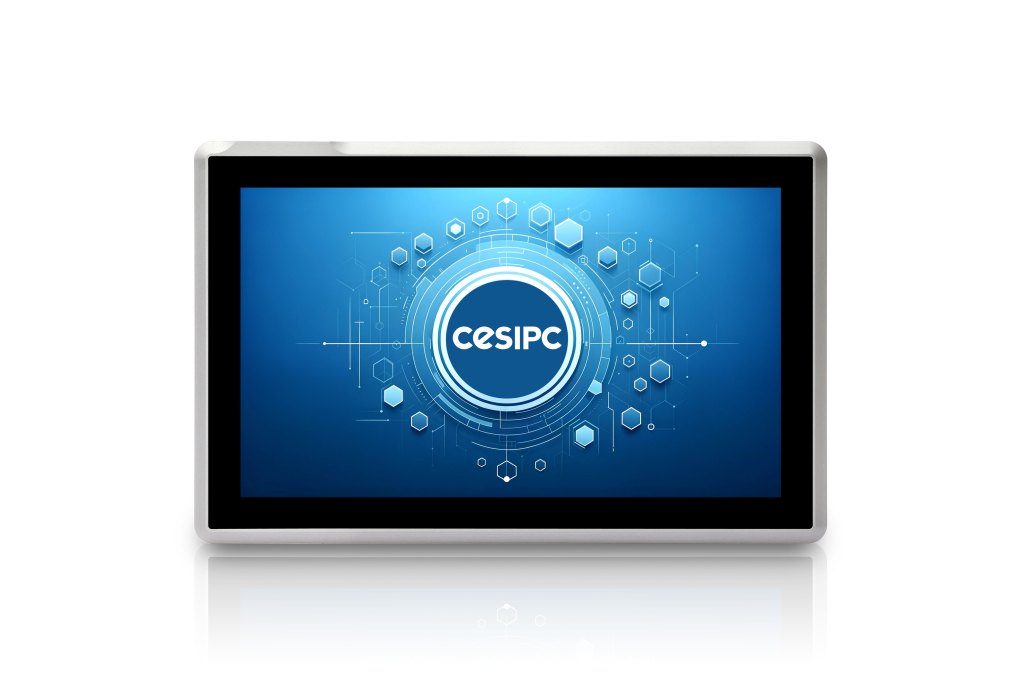
Combining P-CAP technology with Panel PC design brings powerful benefits across industries:
| Advantage | Description |
|---|---|
| High precision & sensitivity | Accurate touch detection with fast response time. Can be calibrated for glove or wet-hand operation. |
| Superior durability | Scratch-resistant, water- and dust-proof, suitable for harsh environments. |
| High optical clarity | Ensures bright, vibrant image quality. |
| Flexible usability | Ideal for public kiosks, medical equipment, industrial control, or conference systems. |
| Sleek, modern design | Flat, seamless glass front that’s easy to clean and aesthetically pleasing. |
5. Typical Applications
- Industrial automation terminals — Machine control, monitoring, and HMI systems
- Medical equipment — Easy to disinfect, no mechanical buttons
- Smart retail & kiosks — Payment, ticketing, or self-service terminals
- Vehicle and marine systems — High brightness and vibration resistance
- Education and meeting systems — Multi-user collaboration and interactive presentations
6. Conclusion
The Projected Capacitive 10-Point Multi-Touch Panel PC represents the perfect combination of smart interaction, durability, and design.
It delivers responsive, precise, and reliable performance for modern industrial and commercial applications.
In short:
Projected Capacitive 10-Point Touch Panel PC = Smart + Accurate + Durable + Intuitive.
Talk to a CESIPC Engineer
Our application engineers are ready to help you select the right configuration, discuss ODM requirements, or provide a tailored quotation for your project.
Typical response within 24 hours · Multilingual support · CE / FCC / BIS compliant

