



Industrial PCs (IPCs) are the backbone of modern automation, embedded control, and edge computing. Unlike consumer-grade computers, IPCs must operate reliably under challenging environmental conditions, including wide temperature variations. But how wide is the operating range, and what design principles make this possible? First: IPC at 0–60°C
Standard Operating Temperature Range: 0–60°C
Most commercial-grade and standard industrial PCs are specified for an operating temperature of 0–60°C. This specification is aligned with typical IEC 60068 environmental test standards and is adequate for indoor automation systems, production lines, machine vision, and process control.
- Why 0–60°C?
- Component ratings: Conventional DRAM, storage devices, and CPUs are often only validated within this band.
- Thermal management: Airflow and passive cooling are designed around this range.
- Reliability balance: Extending beyond 60°C without wide-temp parts risks failure, such as data corruption or thermal throttling.
IPC at 0–60°C
For environments such as factory floors or control rooms, an IPC at 0–60°C is the optimal choice, balancing cost, reliability, and performance.
Wide-Temperature IPCs: -40–85°C
When IPCs are deployed in outdoor, transportation, oil & gas, or defense applications, the environment can far exceed the standard 0–60°C. For this, manufacturers develop wide-temperature IPCs, rated from -40°C to 85°C.
Key Engineering Adaptations:
- Wide-Temperature Memory & Storage
- Use of industrial-grade DDR RAM and wide-temp SSDs (instead of mechanical HDDs).
- NAND flash controllers designed for data integrity at temperature extremes.
- Thermal & Mechanical Design
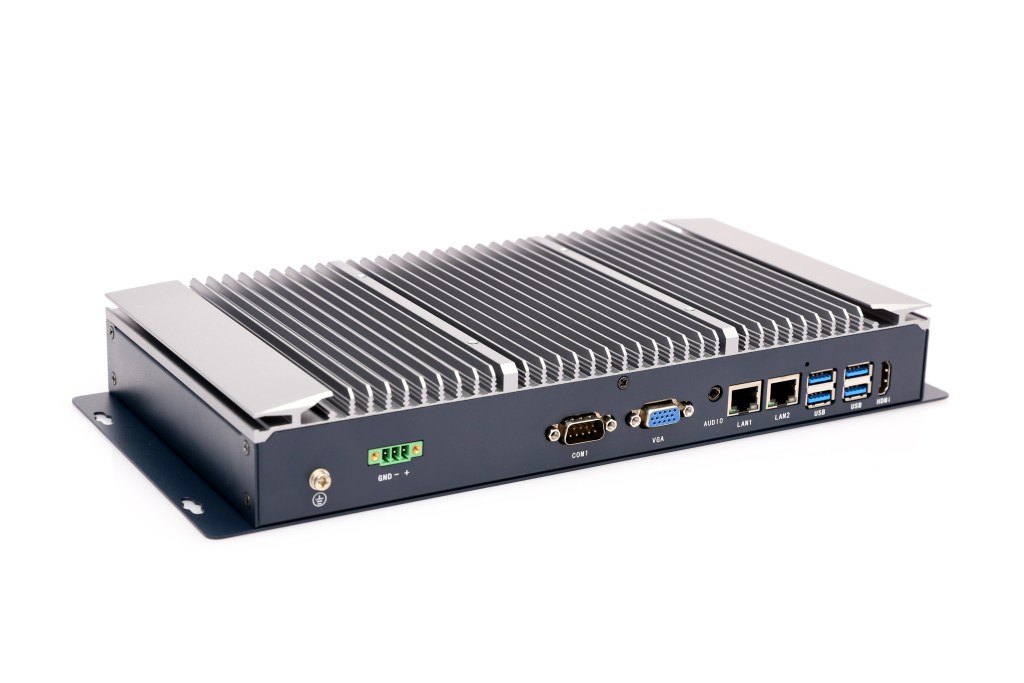
- Fanless chassis with heat-pipes, vapor chambers, or conduction-cooled housings.
- Ruggedized enclosures tested under MIL-STD-810G vibration and temperature cycling.
- CPU and Chipset Selection
- Embedded CPUs (e.g., Intel Atom, ARM-based SoCs) validated for extended operating ranges.
- Derated clock frequencies at higher ambient temperatures to prevent thermal runaway.
- Power Supply Design
- Industrial DC/DC converters capable of cold-start at -40°C.
- Conformal coating for protection against condensation and corrosion.
Recommend Industrial PC
How to Choose the Right IPC
- Controlled Environments (Indoor, Smart Factories)
→ An IPC at 0–60°C provides reliable, cost-effective performance. - Extreme Environments (Outdoor, Defense, Mining, Transportation)
→ Wide-temperature IPCs (-40–85°C) are essential for operational stability. - Mission-Critical Systems
→ Consider IPCs with redundant storage, ECC memory, and MIL/IEC certifications.
Conclusion
Industrial PCs can generally be grouped into two categories:
- Standard IPCs: Rated for 0–60°C, suitable for most industrial and automation tasks.
- Wide-Temperature IPCs: Rated for -40–85°C, designed for harsh outdoor and mission-critical applications.
In short, an IPC at 0–60°C is sufficient for standard factory environments, while wide-temperature IPCs extend operational boundaries into extreme climates, supported by specialized hardware and rigorous engineering standards.
Contact CESIPC Team


