



What is Burn-in Test of IPC?
The Burn-in Test of IPC (Industrial PC) is a critical quality control procedure designed to evaluate the stability, durability, and reliability of industrial computers before they are delivered to customers. Unlike commercial PCs, IPCs are deployed in demanding environments such as factory automation, power plants, medical systems, transportation, and military applications, where downtime is not acceptable.
During a burn-in test, the IPC or its components are exposed to elevated temperature, voltage stress, and heavy workloads for an extended period. This process accelerates potential failures and ensures that only stable and reliable units reach the market.
Why Industrial Computers Need Burn-in Testing
Industrial computers are mission-critical devices. A failure in production lines, rail systems, or energy plants can cause huge financial losses and safety risks. The Burn-in Test of IPC addresses these challenges by:
- Detecting early-stage failures – By running IPCs under stress, weak components are identified before shipping.
- Validating component quality – Every batch of materials and parts is verified for stability and consistency.
- Ensuring long-term reliability – IPCs must perform under extreme conditions such as high temperature, humidity, vibration, and electromagnetic interference.
- Reducing maintenance costs – Burn-in testing lowers the “infant mortality rate” of electronics, cutting down on after-sales repairs.
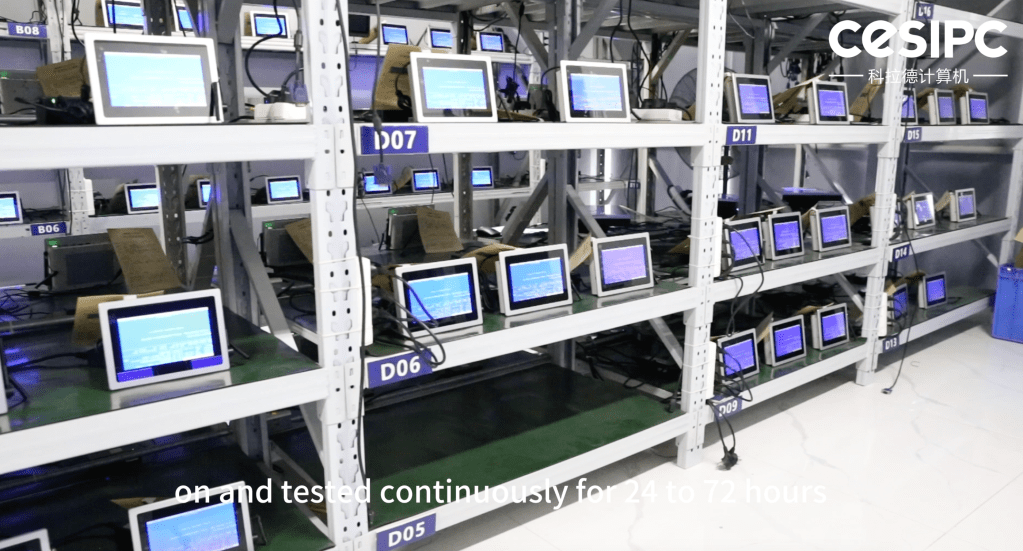
CESIPC Industrial Computers Burn-in Test
How Burn-in Tests Are Conducted on IPCs
The burn-in process includes several testing stages, each replicating real-world industrial challenges:
- High-temperature operation – Running the IPC in controlled chambers at 50°C–70°C for hours or days.
- Voltage fluctuation simulation – Stressing the power supply and motherboard to confirm stable performance under unstable power input.
- Full-load testing – Forcing CPU, GPU, memory, and storage to operate at maximum load continuously.
- Environmental simulation – Adding vibration, humidity, and EMC (Electromagnetic Compatibility) interference tests.
Through these measures, manufacturers ensure that only robust IPCs pass the burn-in test and are ready for deployment.
Benefits of Burn-in Testing for Industrial Computers
The Burn-in Test of IPC provides both manufacturers and customers with clear advantages:
- High product reliability – IPCs can be trusted in 24/7 operations.
- Lower failure rates – Early detection of weak parts prevents field breakdowns.
- Stronger brand reputation – Customers gain confidence in quality assurance processes.
- Optimized total cost of ownership (TCO) – Stable IPCs reduce downtime and repair costs.
Conclusion
The Burn-in Test of IPC is more than just a quality control step; it is a guarantee of reliability, performance, and customer trust. By subjecting industrial PCs to rigorous stress tests, manufacturers ensure that these systems are built to last, even in the harshest environments.
For industries that depend on continuous uptime and mission-critical performance, choosing an IPC that has passed strict burn-in testing is essential.
Contact CESIPC Team


