
An EPC-302A industrial PC was customized with 4×RS-485 interfaces, surge protection, GPIO, and a relay module to support communication and control inside a lithium battery energy storage cabinet.
In an energy storage cabinet, an industrial PC may need to do more than run software. It may also need to communicate with multiple industrial devices, process digital signals, and provide control outputs.
For an energy storage application at Lanhai Energy, CESIPC customized an EPC-302A industrial PC around these requirements. The project required four RS-485 interfaces with surge protection, GPIO-based signal handling, and a relay module capable of switching loads up to 3A.
This case shows how an industrial PC can be adapted to the actual I/O and control architecture of an energy storage cabinet, rather than being selected based on CPU performance alone.
Project Background

Lanhai Energy. Its business scope covers areas including energy storage technology services, battery sales, power equipment, photovoltaic equipment, software development, and intelligent power transmission and distribution equipment.
For this project, CESIPC supplied an EPC-302A industrial PC as part of an energy storage cabinet control solution.
The requirement was not simply to install a computer inside the cabinet. The industrial PC needed to serve as a computing and I/O platform capable of communicating with multiple devices while also handling digital control signals.
This made the I/O architecture an important part of the industrial PC selection.
Project Requirements
The final configuration was determined by four main requirements.
1. Four RS-485 Interfaces
The energy storage cabinet required 4× RS-485 communication interfaces.
RS-485 is widely used for industrial device communication because it supports multi-device communication and is suitable for electrically demanding industrial environments.
In this application, four independent RS-485 channels provided the required communication capacity between the industrial PC and connected devices inside the cabinet.
The requirement was therefore not simply for “more COM ports.” The type of serial interface was important.
2. RS-485 Surge Protection
The project also required surge protection for the RS-485 interfaces.
In an industrial control system, communication interfaces are exposed to the electrical environment of the equipment they connect to. For this reason, the interface design needs to consider not only communication capability but also electrical protection.
For this project, surge protection was incorporated into the customized RS-485 interface configuration.
This is an important distinction between a standard office computer with serial expansion and an industrial PC designed around a specific control environment.
3. GPIO for Digital Signal Control
The application required GPIO for digital signal handling and control.
The standard EPC-302A platform provides 8×8 digital GPIO, consisting of 8 digital inputs and 8 digital outputs. The GPIO supports configurable 24V, 12V, and 5V levels and MODBUS compatibility.
GPIO provides a direct digital interface between the computing platform and external equipment.
Instead of relying entirely on conventional computer peripherals, the industrial PC can receive digital status signals and issue digital control signals as part of the equipment’s control architecture.
4. Higher-Current Switching
The project also required a switching capability of up to 3A.
The GPIO output was not used as the direct load-switching path. Instead, CESIPC integrated a relay module into the industrial PC.
The relay is operated by the GPIO control signal, while the relay contacts handle the higher-current switching path.
The basic control relationship is:
Industrial PC → GPIO → Relay → External Load
This approach allows the computing platform to provide the control signal while the relay provides the required switching capability.
The CESIPC Solution: EPC-302A Industrial PC
CESIPC selected the EPC-302A as the base industrial computing platform.
The EPC-302A is a fanless embedded industrial PC designed for applications requiring industrial I/O, compact installation, and reliable DC power input.
The standard platform supports:
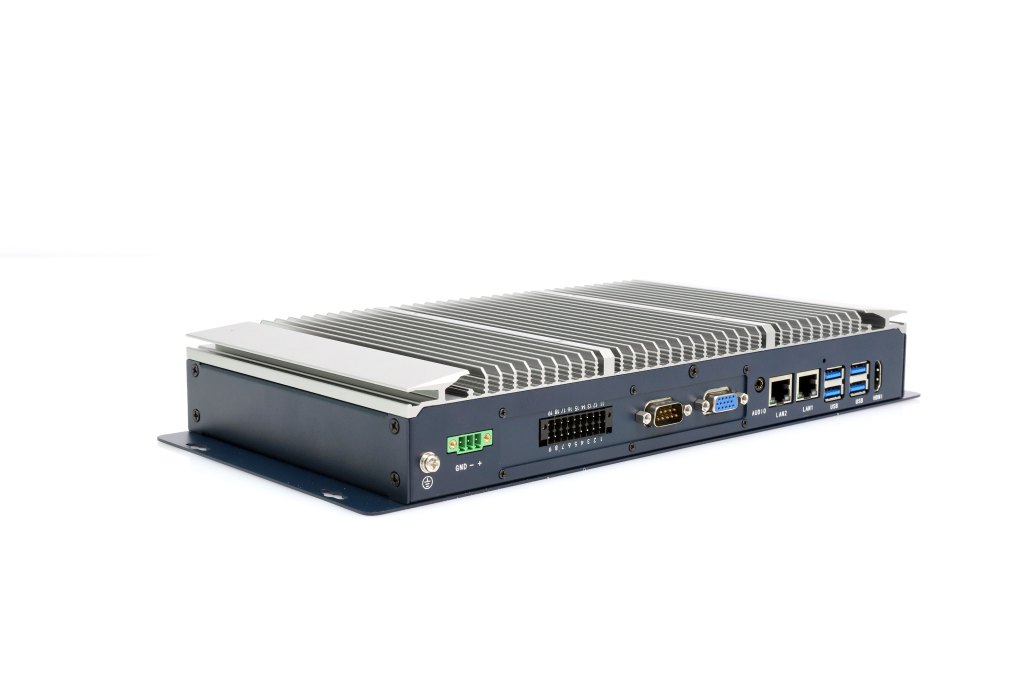


- Intel® Core™ processors up to 12th generation
- 8×8 digital GPIO
- Dual Intel® I210 Gigabit Ethernet
- 9–36V DC wide-range power input
- Dual M.2 2280 NVMe storage expansion
- M.2 2230 Wi-Fi expansion
- TPM 2.0
- Fanless operation
- 6061 aluminum alloy enclosure
- 337 × 160 × 47.5 mm dimensions
- Approximately 2.3 kg weight
The compact form factor allows the industrial PC to be installed inside equipment where space is more limited than in a conventional control-room computer installation.
However, the standard product configuration was not used directly for this project.
CESIPC customized the I/O configuration according to the customer’s actual requirements.
Project-Specific Configuration
| Requirement | CESIPC Solution |
|---|---|
| Industrial computing | EPC-302A Industrial PC |
| GPIO | 8×8 digital I/O platform |
| Serial communication | 4× RS-485 |
| RS-485 protection | Surge protection |
| Higher-current switching | Integrated relay |
| Maximum switching load | Up to 3A |
| Power input | 9–36V DC |
| Cooling | Fanless |
The important point is that the 4× RS-485 interfaces and relay configuration were project-specific customizations, rather than simply representing the standard EPC-302A specification.
GPIO and Relay in the Energy Storage Cabinet
A conventional PC is primarily designed to process data and communicate through standard computer interfaces.
An industrial control computer often has a different role.
Depending on the application, it may need to:
- Receive digital status signals
- Send digital control signals
- Communicate with industrial devices
- Monitor equipment status
- Trigger external devices
- Coordinate control functions
- Interface with a larger automation system
This is where GPIO becomes useful.
The EPC-302A’s GPIO platform provides 8 digital inputs and 8 digital outputs, with configurable 24V, 12V, and 5V levels.
For an energy storage cabinet, these digital I/O channels can form part of the connection between the computing platform and the cabinet’s control architecture.
Why was the relay necessary?
The project required switching capability of up to 3A.
Rather than using the GPIO output directly for the external load, the control signal operates an integrated relay:
GPIO output → Relay control → Relay contacts → External load
This separates the control signal from the higher-current switching path.
Therefore, it is more accurate to describe the relay as providing higher-current switching capability, rather than saying that the relay “increases the GPIO current.”
This distinction is important when designing industrial I/O systems.
Four RS-485 Ports with Surge Protection
The second major part of the customization was the serial communication interface.
The project required four RS-485 channels, each with surge protection.
The basic communication architecture can be represented as:
Industrial PC → 4× RS-485 → Industrial Devices / Controllers
Four RS-485 interfaces allow the industrial PC to communicate with multiple connected devices without relying on a single shared interface configuration.
The surge protection was added according to the project’s electrical requirements.
This means the customization involved more than simply replacing RS-232 with RS-485. The interface design also considered the electrical protection requirements of the deployment environment.
Standard EPC-302A vs. Project Configuration
The distinction is important:
Standard EPC-302A:
4× RS-232 interfaces
This project:
4× RS-485 interfaces + surge protection
CESIPC’s modular BlockCore™ / LEGO MODE architecture supports customized I/O configurations, including interfaces such as RS-232, RS-485, DI, DO, USB, LAN, HDMI, VGA, and other application-specific options.
This modular approach allows the base industrial PC platform to be adapted to the requirements of different industrial systems.
How the Industrial PC Fits into the Energy Storage Cabinet
The EPC-302A does not work as an isolated computer inside the cabinet.
It forms part of a larger communication and control architecture.
A simplified representation of this project is:
Energy Storage Cabinet
↓
Industrial Devices / Signals
↓
4× RS-485
↓
CESIPC EPC-302A Industrial PC
↓
GPIO
↓
Relay
↓
External Load / Control Function
The industrial PC therefore combines several functions in one platform:
Computing + Communication + Digital I/O + Switching Control
For a cabinet builder or system integrator, this can reduce the need for separate hardware dedicated to computing, serial communication, digital I/O, and relay control.
More importantly, the hardware can be configured around the actual system architecture.
Why Use an Industrial PC for Battery Energy Storage?
The selection of an industrial PC for a battery energy storage system should start with the application’s control and communication requirements.
CPU performance is only one part of the decision.
Depending on the system architecture, an industrial PC for BESS may need to provide:
- Industrial serial communication
- RS-485 or other field interfaces
- Digital inputs and outputs
- Control outputs
- Wide-range DC power input
- Compact installation
- Fanless cooling
- Industrial-grade mechanical construction
- Long-term industrial deployment capability
The EPC-302A addresses these requirements through its fanless design, 9–36V DC input, configurable GPIO, compact enclosure, and Intel Core processing platform.
In this particular project, however, the most important selection factors were not simply the processor or memory.
The required 4× RS-485 interfaces, surge protection, GPIO, relay switching, and 3A load capability directly influenced the final configuration.
This is why industrial PC selection should begin with the I/O and control architecture, then move to CPU performance and other computing requirements.
From Standard Industrial PC to Application-Specific Solution
One of the challenges in industrial computing is that two applications may require completely different I/O configurations even when they need similar computing performance.
For example, one machine may require:
4× RS-232 + USB + LAN
while another may require:
4× RS-485 + GPIO + relay output + surge protection
The CPU may be similar, but the actual industrial PC configuration is very different.
The EPC-302A project for Lanhai Energy demonstrates this approach.
CESIPC started with an existing industrial computing platform and adapted the interfaces around the customer’s cabinet requirements.
The result was not simply a “PC with more ports.”
It was an application-specific industrial computing and control platform.
Final Configuration
For this energy storage application, the EPC-302A was configured as a dedicated industrial computing and I/O platform rather than a conventional PC.
The final configuration combined:
- 8×8 digital GPIO
- 4× RS-485 communication
- RS-485 surge protection
- Integrated relay
- Up to 3A switching capability
- 9–36V DC power input
- Fanless operation
- Compact industrial enclosure
These specifications were selected around the actual communication and control requirements of the energy storage cabinet.
The case demonstrates an important principle for BESS system integrators:
The right industrial PC is not necessarily the one with the highest CPU performance. It is the one whose computing, communication, I/O, power, and control capabilities match the system architecture.
What This Case Shows
This project illustrates several practical considerations when selecting an industrial PC for energy storage applications.
1. I/O requirements should be defined early
The number and type of communication interfaces can directly affect the industrial PC configuration.
2. GPIO can complement industrial communication
RS-485 can handle communication with external devices, while GPIO can provide direct digital signal handling.
3. Higher-current switching may require an additional interface
When a control output needs to switch a higher-current load, a relay can provide the required switching path rather than connecting the load directly to the GPIO output.
4. Interface protection matters
For industrial communication interfaces, electrical protection can be part of the system requirement, not an optional afterthought.
5. Customization can be more important than CPU selection
An industrial PC that matches the required I/O architecture may be more suitable than a higher-performance computer that lacks the required interfaces.
FAQ
What is an industrial PC with GPIO?
An industrial PC with GPIO combines standard computing functions with digital input/output interfaces. GPIO can be used to receive digital status signals or send digital control signals to external industrial equipment.
Why is GPIO useful in energy storage systems?
GPIO allows an industrial PC to interact with digital signals in an energy storage system. It can complement communication interfaces such as RS-485 when an application requires both device communication and direct digital signal control.
Can an industrial PC be used inside an energy storage cabinet?
Yes. A compact industrial PC can provide computing, communication, monitoring, and control functions inside an energy storage cabinet. Selection should consider the required I/O, power input, installation space, cooling method, operating conditions, and communication interfaces.
Why does an energy storage application need RS-485?
RS-485 is commonly used for industrial device communication. Multiple RS-485 interfaces can be useful when an industrial PC needs to communicate with several external devices or controllers.
Why did this project require four RS-485 ports?
The cabinet required four independent RS-485 communication interfaces for communication with connected industrial devices. The number of interfaces was therefore determined by the system’s communication architecture.
Why was surge protection added to the RS-485 interfaces?
The project required additional protection for the RS-485 communication interfaces. Surge protection was therefore incorporated into the customized interface design to address the electrical requirements of the application.
Why was a relay added to the EPC-302A?
The project required switching capability of up to 3A. The GPIO control signal operates the relay, while the relay contacts handle the higher-current switching path.
Does the standard EPC-302A have four RS-485 ports?
No. The standard EPC-302A specification currently lists 4× RS-232 ports. For this project, CESIPC customized the platform with 4× RS-485 interfaces and surge protection according to the customer’s requirements.
What should you consider when selecting an industrial PC for BESS?
Consider the required communication interfaces, digital I/O, control outputs, power input range, electrical protection, installation space, cooling method, operating environment, and long-term availability. The I/O and control architecture should be defined before selecting the CPU and memory configuration.
Can an industrial PC with GPIO control a relay?
Yes. GPIO can provide the control signal for a relay module. In this project, the EPC-302A GPIO output operated the integrated relay, while the relay contacts provided the switching path for loads up to 3A.
Conclusion
The Lanhai Energy project demonstrates how an industrial PC can be configured around the practical requirements of a battery energy storage cabinet.
The solution was based on an EPC-302A industrial PC with 8×8 digital GPIO, customized 4× RS-485 communication with surge protection, and an integrated relay for switching loads up to 3A.
The key engineering decision was not simply choosing a faster processor. It was matching the industrial computer’s communication, digital I/O, switching, power, and mechanical requirements to the cabinet’s control architecture.
For BESS system integrators, cabinet manufacturers, and industrial automation engineers, this approach provides a practical way to build a compact computing and control platform around the actual requirements of the system.
Looking for an industrial PC with GPIO, RS-485, relay output, or customized I/O for an energy storage application? Contact CESIPC to discuss your required configuration.


We use your details only to answer this enquiry — no newsletters, no sharing. Drawings or a photo of the existing panel can be sent to sales@cesipc.com.