





CNC plasma cutting machines are widely used in metal fabrication.
They are fast, powerful, and designed for continuous industrial operation.
But behind the cutting torch and motion system, there is another critical component.
The industrial computing platform.
In plasma cutting applications, the stability of the control system is just as important as cutting power.
Operating Characteristics of CNC Plasma Cutting Machines
Plasma cutting environments are harsh by design.
They typically involve:
- High current and strong electromagnetic interference (EMI)
- Continuous vibration and mechanical shock
- Heavy metal dust and fine conductive particles
- Long operating hours, often 24/7
This is not a clean or friendly environment for electronics.
Any computing platform used here must be designed for industrial conditions from the start.
What Does the Industrial PC Control in a Plasma Cutting System?
In a CNC plasma cutting machine, the industrial PC is not a passive display device.
It is the core control platform.
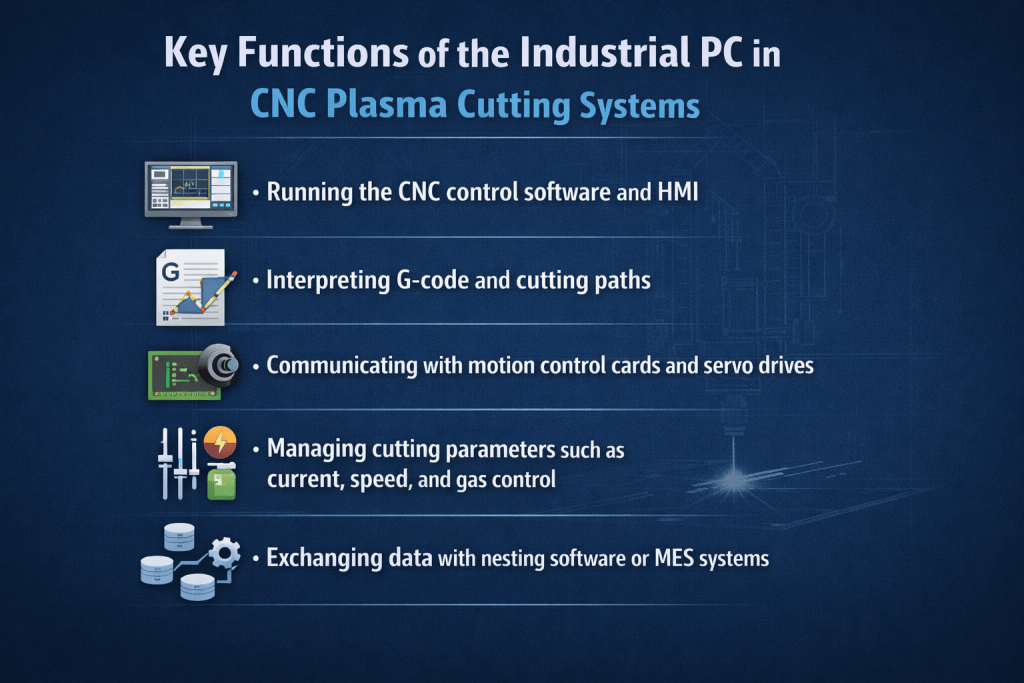
- Running the CNC control software and HMI
- Interpreting G-code and cutting paths
- Communicating with motion control cards and servo drives
- Managing cutting parameters such as current, speed, and gas control
- Exchanging data with nesting software or MES systems
In practice, cutting accuracy and process stability depend heavily on the reliability of this platform.
Industrial PCs with high computing performance can meet the demands of complex multi-axis and multi-process machining, supporting up to 64 interpolation axes, 64 total axes, and 24 machining processes, with a minimum clock cycle of 500 microseconds.
A powerful cutting torch cannot compensate for an unstable control system.
Why Commercial PCs Fail in Plasma Cutting Applications
Commercial PCs are designed for offices, not factory floors.
In plasma cutting environments, they often encounter problems such as:
- System crashes caused by EMI
- Unstable USB or serial communication
- Overheating during long operating cycles
- Premature failure due to dust and vibration
These issues usually appear gradually.
But once they occur during cutting, production stops immediately.
In plasma cutting, stability matters more than peak performance.
Key Requirements for Industrial PCs in Plasma Cutting Machines
To operate reliably, an industrial PC must meet several practical requirements.
Typical expectations include:
- Strong EMI and ESD protection
- Industrial-grade motherboard design
- Long-term component availability
- Multiple stable serial and industrial I/O interfaces
- Wide-range DC power input to handle voltage fluctuation
- Fanless design to prevent dust ingress
- Support for continuous 24/7 operation
These requirements are driven by real production conditions, not specifications on paper.
The Role of CESIPC in CNC Plasma Cutting Projects
In CNC plasma cutting projects, CESIPC typically acts as an industrial computing platform provider rather than a simple hardware supplier.
This usually includes:
Defining the role of the computing platform within the CNC system architecture
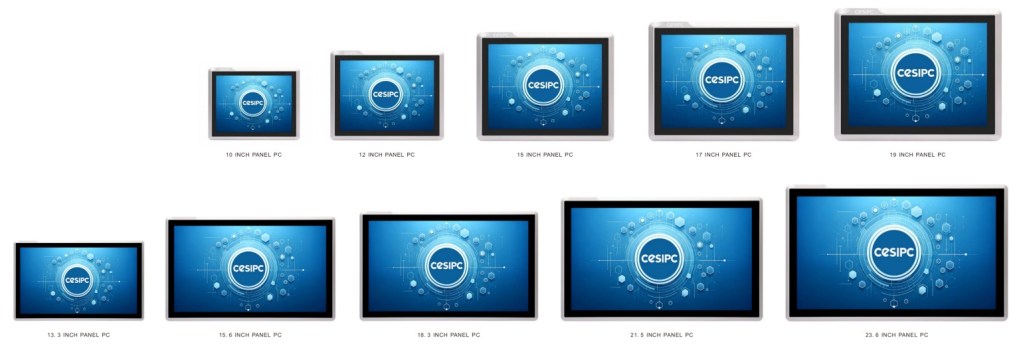
Selecting IPC or Panel PC form factors based on machine structure
Supporting system validation and platform freeze
Ensuring long-term supply consistency across the equipment lifecycle
The focus is not on a single delivery.
It is on how the platform behaves over years of continuous operation.
Recommend Industrial PC:

A System-Level Perspective
In CNC plasma cutting machines:
- The cutting torch determines whether material can be cut
- The motion system determines cutting accuracy
- The industrial computing platform determines long-term system stability
Plasma cutting is a system.
And every stable system starts with a reliable industrial computing foundation.


