
–Episode 3–
Understanding the Core Components of a CNC System
Introduction
When people first encounter CNC equipment, they often focus on the machine itself.
They see a milling machine, a lathe, or a cutting center.
However, CNC is not a single piece of hardware.
It is a system composed of multiple tightly coordinated components.
Each component has a clear responsibility.
Precision machining only becomes possible when these components operate together.
In this article, we explain why CNC must be understood as a system.
We also break down the key components of a complete CNC system.
This system-level view explains why modern CNC relies on stable industrial computing platforms.
CNC Works as a System, Not as Individual Parts
A CNC machine does not rely on one dominant component.
Accuracy and repeatability come from coordination.
Mechanical structure provides stability.
Drive systems generate motion.
Control systems calculate commands.
Software defines intent.
Auxiliary systems keep everything running.
If any part becomes unstable, the entire system is affected.
This is why CNC engineering focuses on system architecture, not isolated components.
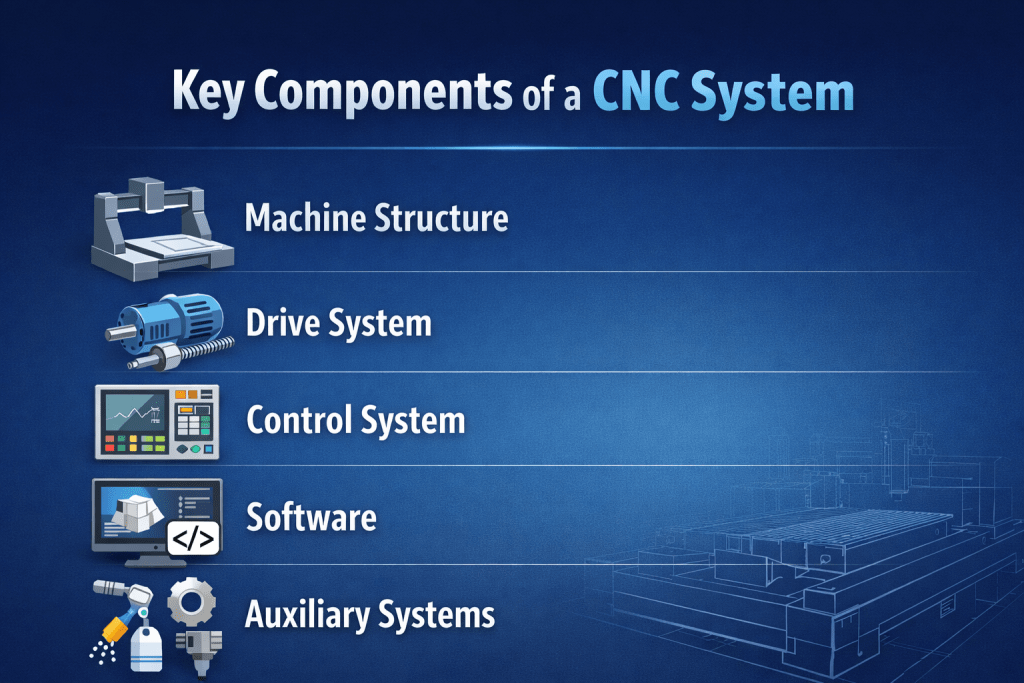
Five Key Components of a CNC System
Machine Structure
The machine structure is the physical foundation of the CNC system.
It keeps the entire machine stable during machining.
A rigid frame reduces vibration.
It helps maintain accuracy over long production cycles.
Without a stable structure, even the best control system cannot maintain precision.
Drive System
The drive system moves the machine along different axes.
It includes motors, drives, and mechanical transmission components.
Its task is to convert control commands into precise motion.
Speed, positioning accuracy, and repeatability depend heavily on this system.
Small deviations at this level can directly affect machining quality.
Control System
The control system is the brain of the CNC system.
It reads G-code and determines how the machine should move.
The controller calculates positions, speeds, and acceleration profiles.
It also coordinates multiple axes at the same time.
Modern CNC controllers rely on real-time computation.
They must deliver predictable results at every control cycle.
Software
Software defines what the machine should produce.
It connects design intent to physical motion.
CAD software creates the part geometry.
CAM software converts geometry into machining paths.
These paths are translated into G-code.
The control system then executes this code step by step.
As machining becomes more complex, software becomes increasingly critical.
Auxiliary Systems
Auxiliary systems support stable and continuous operation.
They do not cut material, but they are essential.
These systems typically include:
- Cooling systems
- Chip removal systems
- Measurement and feedback devices
They help maintain process stability, safety, and consistency during production.
Where Industrial Computing Platforms Fit into the CNC System
As CNC systems evolved, software and data handling became more complex.
Visualization, diagnostics, parameter management, and communication all expanded.
This created the need for a reliable computing layer.
Industrial computing platforms are used to support:
- HMI operation
- System monitoring and diagnostics
- Data handling and communication
Unlike consumer PCs, these platforms must operate continuously.
They must tolerate vibration, temperature changes, and long duty cycles.
CESIPC’s industrial computing platforms are designed specifically for CNC environments.
They support CNC systems as stable infrastructure rather than as general-purpose computers.
The focus is long-term predictability.
This system-level reliability is essential for modern CNC equipment.
Why This System Perspective Matters
Understanding CNC as a system explains many design choices.
It explains why:
- CNC machines emphasize stability over peak performance
- Software and hardware responsibilities are clearly separated
- Industrial computing platforms are preferred over consumer computers
This perspective is critical for machine builders, system integrators, and end users.
Conclusion
CNC is not a single machine.
It is a coordinated system of structure, motion, control, software, and support systems.
Each component plays a defined role.
Precision and repeatability emerge from their cooperation.
As CNC systems continue to evolve, computing becomes even more important.
Stable industrial computing platforms form the foundation for long-term operation.
By supporting CNC systems at the architectural level, CESIPC provides industrial computing platforms that align with real CNC engineering requirements, not just hardware specifications.
Contact CESIPC Team


We use your details only to answer this enquiry — no newsletters, no sharing. Drawings or a photo of the existing panel can be sent to sales@cesipc.com.