





–Episode 4–
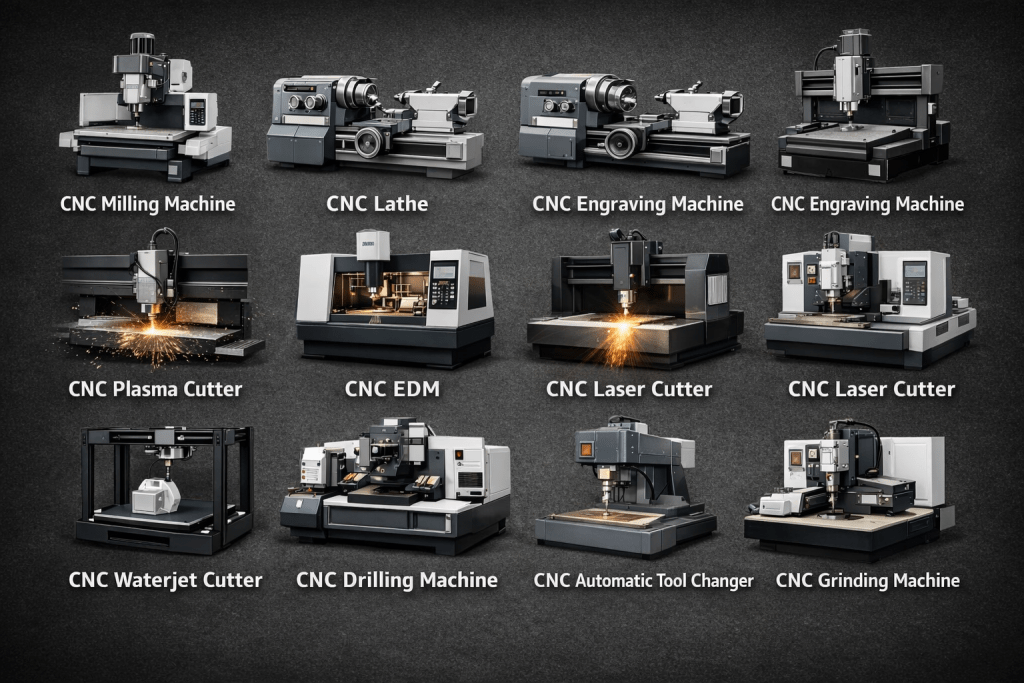
When people hear “CNC equipment,” they often think of one specific machine.
In reality, CNC technology covers a wide range of equipment types.
Each CNC machine serves a different manufacturing purpose.
However, they all rely on the same core CNC system logic.
In this article, we review the main types of CNC equipment used in industry today.
We also explain what they have in common at the system level.
This helps clarify why stable industrial computing platforms are essential across CNC applications.
CNC Milling Machines
CNC milling machines are among the most common CNC equipment types.
They remove material using rotating cutting tools.
Milling machines are widely used for complex shapes and precision parts.
They are common in mold making, aerospace, and mechanical manufacturing.
These machines often require multi-axis control and high computing stability.
CNC Lathes
CNC lathes are designed for rotational machining.
The workpiece rotates while the cutting tool remains stationary or moves linearly.
They are typically used for shafts, cylinders, and symmetrical parts.
High repeatability is critical in these applications.
Stable CNC control and motion coordination are essential for surface quality.
CNC Engraving Machines
CNC engraving machines focus on fine detail work.
They are used for signage, panels, molds, and decorative components.
Although smaller in size, they still rely on precise motion control.
System stability directly affects engraving quality.
CNC Plasma Cutting Machines
CNC plasma cutting machines use high-temperature plasma to cut metal sheets.
They are commonly used in steel fabrication and heavy industry.
These machines emphasize cutting speed and path accuracy.
Real-time control and reliable system operation are critical.
CNC EDM Machines (Electrical Discharge Machining)
CNC EDM machines remove material using electrical discharges.
They are used for hard materials and complex internal geometries.
EDM processes require precise control over timing and energy.
System consistency is more important than raw speed.
CNC Laser Cutting Machines
CNC laser cutting machines use focused laser beams to cut materials.
They are widely used in sheet metal processing and electronics.
Laser systems demand high precision and stable motion control.
Software and control coordination play a major role.
3D Printing Systems (Additive Manufacturing)
Modern CNC classifications often include industrial 3D printing systems.
These machines build parts layer by layer.
Although the process is additive, control logic is still CNC-based.
Motion accuracy and software reliability remain critical.
Multi-Axis CNC Machines
Multi-axis CNC machines go beyond three-axis motion.
They are used for complex geometries and advanced machining.
These machines place high demands on control algorithms.
They also require stable system integration across hardware and software.
CNC Automatic Tool Changers (ATC)
Automatic tool changers are key CNC subsystems.
They enable continuous machining without manual intervention.
ATC systems must operate reliably over long cycles.
Coordination with the CNC controller and PLC is essential.
CNC Waterjet Cutting Machines
CNC waterjet machines use high-pressure water to cut materials.
They are suitable for metals, stone, glass, and composites.
Cutting paths must be precisely controlled.
System stability directly affects cutting accuracy.
CNC Drilling Machines
CNC drilling machines focus on repetitive hole-making operations.
They are common in electronics, automotive, and structural components.
Precision and repeatability are critical.
Consistent CNC system behavior ensures quality.
CNC Grinding Machines
CNC grinding machines are used for high-precision finishing.
They operate with very tight tolerance requirements.
Any system instability can affect surface quality.
Reliable control and long-term accuracy are essential.
What All CNC Equipment Has in Common
Despite their differences, all CNC machines share common system requirements:
- Precise motion control
- Reliable software execution
- Stable human-machine interfaces
- Long-term operational consistency
This is why CNC equipment should be viewed as systems, not just machines.
The Role of Industrial Computing Platforms in CNC Equipment
As CNC equipment becomes more complex, computing plays a larger role.
Visualization, diagnostics, data handling, and HMI functions continue to expand.
Industrial computing platforms support these functions.
They act as a stable foundation for CNC system operation.
CESIPC’s industrial computing platforms are designed specifically for CNC environments.
They are commonly used to support HMI systems, integration layers, and long-term operation.
The focus is not peak performance.
The focus is predictable behavior over years of continuous use.
This system-level reliability is essential across all CNC equipment types.
Conclusion
CNC equipment includes a wide range of machines.
From milling and turning to laser cutting and grinding.
Although their processes differ, they share the same CNC system principles.
Control, motion, software, and computing must work together.
Understanding CNC equipment from a system perspective explains why industrial computing platforms are critical.
By supporting CNC systems at this level, CESIPC contributes as an industrial computing expert within the CNC ecosystem, not just as a hardware supplier.


