
In modern industrial automation and embedded systems, serial communication plays a critical role. Serial communication refers to the exchange of data between two or more devices through a serial data transmission protocol. In industrial computers, serial communication is widely used for communication between sensors, controllers, actuators, and other devices. Among the many serial communication standards, asynchronous serial ports are among the most common. But what exactly is an asynchronous serial port in industrial computers? And what other types of serial communication methods are there? This article provides a simple introduction.
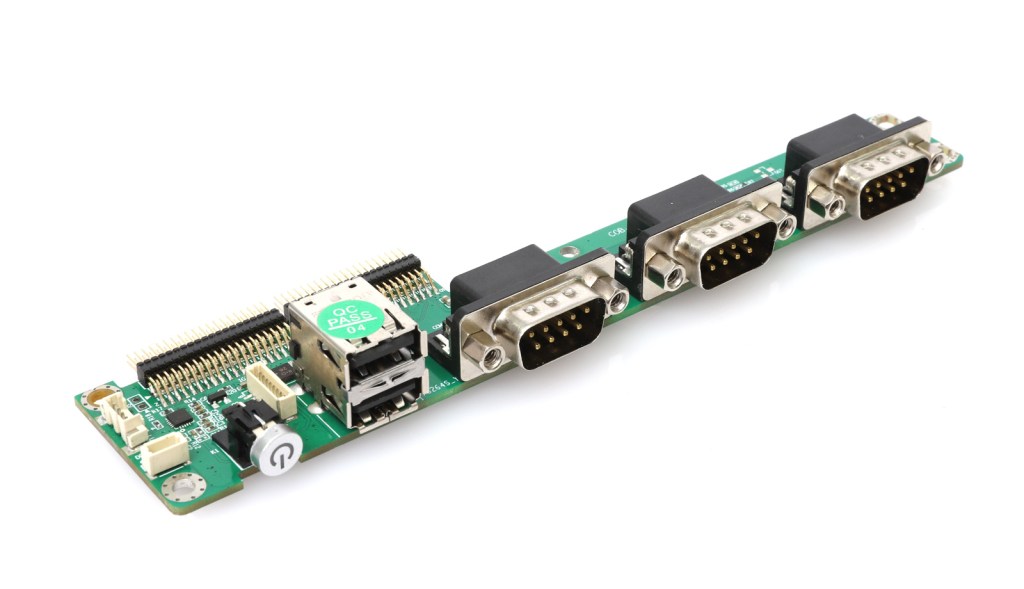
What is an Asynchronous Serial Port?
An asynchronous serial port is a common serial communication method where data transmission does not rely on a shared clock signal. Instead, data is synchronized based on a predefined baud rate. In other words, the sender and receiver do not need to use the same clock in real-time. Instead, the data is transmitted using a specific frame format (such as start bits, data bits, stop bits, etc.) to ensure accurate transmission.
In industrial computers, RS-232 is the most common asynchronous serial standard. It sends and receives digital signals in a series to exchange data. During communication, the data is packaged into frames, which contain the start bit, data bits, optional parity bit, and stop bit. The start bit marks the beginning of the data, and the stop bit marks the end. The receiver synchronizes with the sender through the agreed baud rate, ensuring data transmission.
The advantage of asynchronous serial ports lies in their simple implementation and low cost, making them suitable for low-speed, short-distance data transmission. They are commonly used in industrial control systems, embedded systems, and communication between peripheral devices.
What Other Serial Communication Methods Exist?
Apart from asynchronous serial ports, there are several other types of serial communication methods that are used for communication between industrial computers and other devices. Here is a brief overview of some common serial communication methods:
1. RS-485 (Differential Signal Serial Port)
RS-485 is a commonly used serial communication standard in industrial automation, building control, and remote monitoring systems. Unlike RS-232, RS-485 supports multipoint communication, meaning it can connect multiple devices on the same bus (up to 32 devices). It uses differential signal transmission, which provides high resistance to interference, making it suitable for long-distance communication (up to 1200 meters). RS-485 supports both half-duplex and full-duplex communication, offering higher reliability and stability.
2. RS-422 (Differential Signal Serial Port)
RS-422 is similar to RS-485, also using differential signal transmission, making it suitable for long-distance communication (up to 1200 meters). However, unlike RS-485, RS-422 typically only supports unidirectional communication, meaning there are separate devices for sending and receiving. It is often used in applications where long-distance, stable communication is required.
3. TTL Serial Port
TTL serial ports are typically used in embedded systems and microcontroller communication, often seen in development boards (like Arduino and Raspberry Pi) and peripheral devices (such as sensors and actuators). TTL serial ports use simple logic levels (0V for low and 3.3V or 5V for high) to represent data. Due to its lower transmission speed, it is suitable for short-distance, low-power applications.
4. I2C (Inter-Integrated Circuit)
I2C is a synchronous serial communication protocol commonly used in embedded systems for data exchange between integrated circuits (ICs). I2C uses two signal lines: the clock line (SCL) and the data line (SDA). It supports multiple devices on the same bus, making it flexible and scalable for short-distance, low-speed data transmission.
5. SPI (Serial Peripheral Interface)
SPI is a synchronous serial communication protocol commonly used for high-speed data exchange between microcontrollers and peripherals. Unlike I2C, SPI supports full-duplex communication, meaning data can be sent and received simultaneously. SPI uses four signal lines: Master Out Slave In (MOSI), Master In Slave Out (MISO), Clock (SCLK), and Slave Select (SS). SPI offers high transmission speeds, making it suitable for applications requiring fast data exchange.
6. USB (Universal Serial Bus)
USB is a widely used high-speed synchronous communication standard, commonly used for communication between computers and peripherals (such as keyboards, mice, and printers). Although USB is not strictly a traditional serial port standard, it can simulate serial communication through virtual COM ports (VCOM), enabling compatibility with legacy serial devices.
7. CAN (Controller Area Network)
CAN is a synchronous serial communication protocol used in embedded systems and automotive electronics. It is widely used in automotive and industrial control applications where high interference resistance and real-time performance are critical. CAN supports multiple hosts and devices, providing robust fault tolerance, making it ideal for complex industrial applications.
Summary
In industrial computers and embedded systems, serial communication is a crucial method for connecting devices and exchanging data. Asynchronous serial ports (such as RS-232) are widely used due to their simplicity, reliability, and low cost, making them ideal for low-speed communication. However, as needs evolve, other serial communication standards (such as RS-485, TTL serial ports, I2C, SPI, etc.) are increasingly important. Each serial communication method has its own unique advantages and applicable scenarios, and choosing the right one can help meet the demands of industrial automation and embedded systems more effectively.
Contact CESIPC Team

