



Pip: Industrial computing — where the question isn’t whether your PC can run spreadsheets, but whether it can survive a high-pressure steam hose at close range.
Mara: Today we’re looking at water protection standards for panel PCs, courtesy of CESIPC-Summer — covering IP ratings, fanless design, and how to match the right hardware to the right environment.
Pip: Let’s start with what it actually means to build a PC that water can’t kill.
Water-Resistant Panel PCs: Ratings, Design, and the Right Fit
Mara: The central question here is straightforward: when an industrial environment involves moisture, humidity, or direct washdown, what separates a panel PC that survives from one that doesn’t — and how do you choose between protection levels?
Pip: The post draws the line early. The framing is that commercial PCs simply aren’t built for this, and the post puts it plainly: “industrial panel PCs are engineered to endure extreme conditions, offering dust resistance, water resistance via high IP ratings, rugged construction to withstand physical stress, and long-term reliability under continuous use.”
Mara: So the upshot is that IP rating isn’t a marketing badge — it’s the functional specification that determines whether a machine keeps running on a food production line or fails the moment a cleaning crew shows up.
Pip: And the rating system itself has real granularity. IP65 handles water jets from any direction — fine for factory control or mild washdown. IP67 adds submersion up to a meter for thirty minutes, which suits cleanrooms and food manufacturing. IP69K is the ceiling: high-pressure, high-temperature water jets, the kind used in pharmaceutical and beverage facilities.
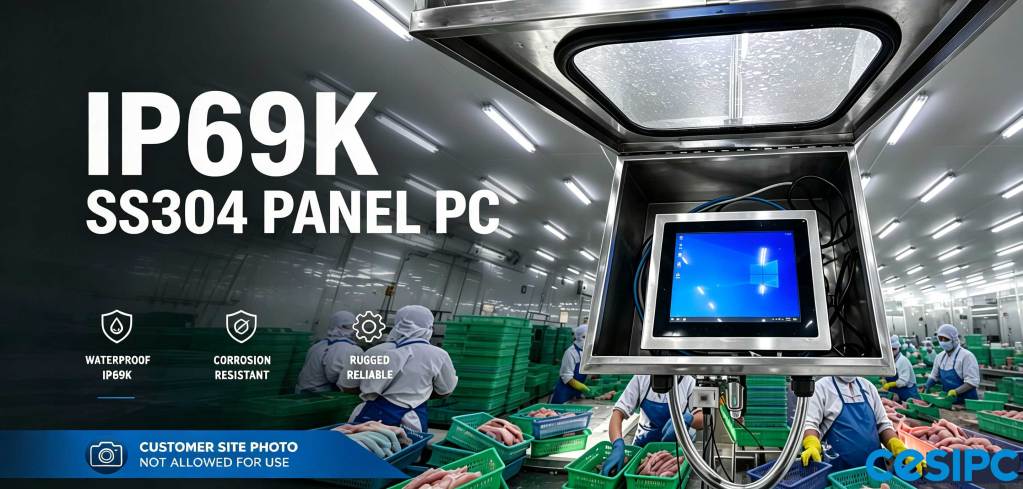
Mara: The fanless design piece connects directly to this. In high-dust environments, a fan-cooled system accumulates particulate internally over time, leading to overheating. Fanless architecture closes that entry point entirely, and the post notes it also reduces power consumption and noise — relevant in precision environments like electronics or pharmaceutical manufacturing.
Pip: The post then gets concrete with a side-by-side of two specific units. The EPC-S19X2A carries an IP65 rating on a 19-inch screen — more affordable, suited to general automation, warehousing, and mild washdown. The WPC-S1022A-G steps up to IP69K in a stainless steel 10-inch form factor, built specifically for food processing lines, beverage and dairy cleaning, and pharmaceutical cleanrooms.

Mara: The scene-specific recommendation table in the post makes the tradeoff explicit: the IP69K unit is listed as “overkill” for general automation and not recommended for logistics — meaning over-specifying carries real cost without operational benefit.
Pip: Right — picking IP69K for a warehouse is like waterproofing a submarine for a puddle.
Mara: Sixteen years of application experience is exactly the kind of context that makes that matching judgment reliable rather than arbitrary.
Pip: Protection levels chosen, hardware matched — the logic here extends well beyond water resistance into everything else an industrial environment can throw at a machine.
Mara: The throughline today is fitness for environment — not maximum specs, but the right specs for the actual conditions.
Pip: A rating system that tells you exactly how much punishment your hardware can take. Next time, we’ll see what other conditions industrial computing has to answer for.
Talk to a CESIPC Engineer
Our application engineers are ready to help you select the right configuration, discuss ODM requirements, or provide a tailored quotation for your project.
Typical response within 24 hours · Multilingual support · CE / FCC / BIS compliant


