
In modern industrial environments, Industrial PCs (IPCs) serve as the brains of automation systems, handling data acquisition, control, and communication. To ensure stable and reliable operation, IPCs must undergo a series of rigorous tests before entering the market—among which EMC (Electromagnetic Compatibility) is one of the most critical. CESIPC All Industrial Computers have passed EMC
What is EMC?
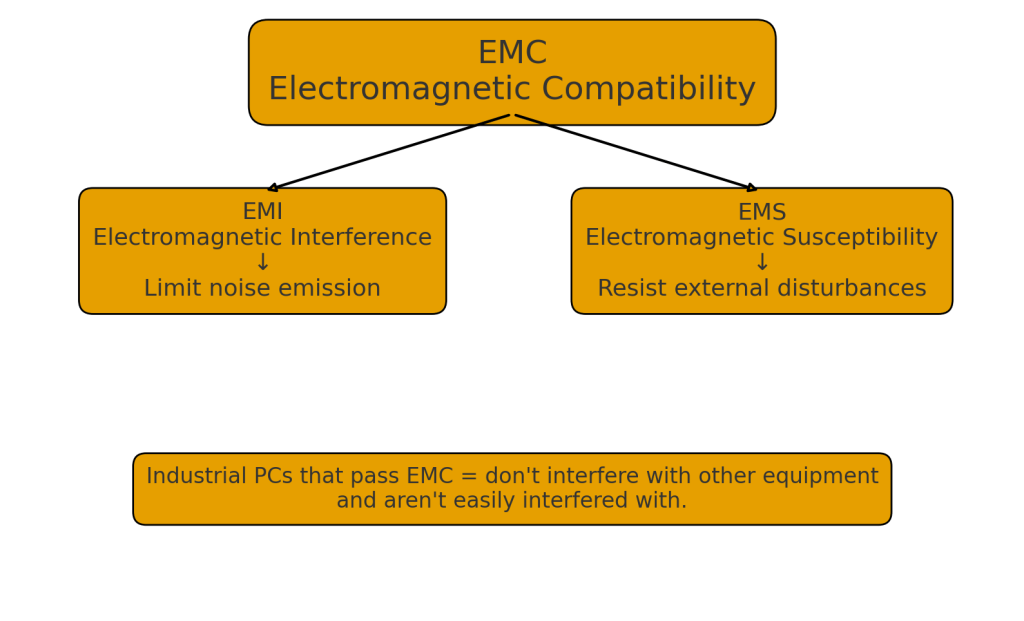
EMC (Electromagnetic Compatibility) refers to the ability of electronic equipment to operate properly in an electromagnetic environment, without generating excessive interference to other devices. It has two key aspects:
- EMI (Electromagnetic Interference)
Ensures that the IPC does not emit excessive electromagnetic noise that could disrupt nearby equipment. - EMS (Electromagnetic Susceptibility)
Ensures that the IPC can resist external electromagnetic disturbances, such as electrostatic discharge (ESD), power surges, or radio frequency interference, without malfunctioning.
Why Must Industrial PCs Pass EMC?
1. Reliability in Harsh Environments
Industrial sites are full of electromagnetic noise—large motors, welding machines, and power systems often generate strong disturbances. Without solid EMC performance, IPCs could easily suffer communication failures, control malfunctions, or even cause safety hazards.
2. Protecting Surrounding Equipment
If an IPC generates too much electromagnetic noise, it may affect sensors, communication networks, or even medical equipment. EMC compliance ensures that IPCs operate “quietly,” without disrupting other systems.
3. Regulatory Compliance & Market Access
EMC is a mandatory requirement across global markets:
- Europe: CE certification requires EMC compliance.
- United States: FCC certification includes EMC standards.
- China: CCC certification also covers EMC.
Without passing EMC, IPCs cannot legally enter mainstream markets.
4. Boosting Market Competitiveness
Customers often view EMC performance as a key indicator of product quality. Passing EMC certification demonstrates higher stability and reliability, giving IPCs an advantage in competitive markets.
EMC Testing Example: Electrostatic Discharge (ESD)
One typical EMC test is Electrostatic Discharge (ESD):
- Contact discharge up to 6,000V: The IPC can withstand a direct 6 kV static discharge.
- Air discharge up to 12,000V: The IPC can handle up to 12 kV through-air static discharge.
According to the IEC 61000-4-2 standard, these values exceed common compliance requirements, demonstrating that the IPC is capable of maintaining stable operation even under severe static conditions.
Conclusion
Passing EMC is more than a regulatory requirement—it is a guarantee of reliability, safety, and market competitiveness. An IPC that passes EMC testing can adapt to complex industrial environments, ensure continuous production, and prevent costly failures.
In short: “Only with EMC compliance can Industrial PCs truly be trusted.”