
——2026.06.30
In modern industrial automation, system stability is no longer a competitive advantage—it is a baseline requirement. Whether deployed in smart factories, CNC machines, machine vision systems, or edge computing gateways, industrial computers must operate continuously under electrical noise, temperature fluctuations, and 24/7 workloads.
To meet these challenges, CESIPC designs its industrial PCs with 10-layer PCB motherboards, a key engineering decision that directly impacts system reliability, signal quality, and long-term durability.
What Is a 10-Layer PCB in Industrial Computing?
A Printed Circuit Board (PCB) is the foundation of every industrial computer motherboard, connecting CPUs, memory, storage, and I/O interfaces through copper traces.

A 10-layer PCB means the internal structure of the motherboard is composed of 10 stacked conductive and insulating layers, typically including:
- Signal layers (high-speed data routing)
- Ground planes (GND shielding)
- Power distribution layers
- EMI shielding layers
This multi-layer architecture allows engineers to design far more stable and compact circuit systems compared to lower-layer boards.
10-Layer vs 6–8 Layer Industrial Motherboards
In industrial computing, PCB layer count directly affects electrical performance and system stability.
| Feature | 6–8 Layer PCB | 10-Layer PCB (CESIPC) |
|---|---|---|
| Signal Integrity | Moderate | High stability |
| High-Speed Interfaces | Limited | Fully optimized |
| EMI Resistance | Standard | Strong industrial-grade protection |
| Power Distribution | Basic | More uniform and stable |
| System Integration Density | Lower | Higher complexity support |
| 24/7 Reliability | Standard | Enhanced long-term stability |
The difference is not just structural—it directly impacts real-world performance in noisy industrial environments.
Key Advantages of CESIPC 10-Layer Motherboard Design
1. Improved Signal Integrity for High-Speed Communication
Modern industrial systems rely heavily on high-speed interfaces such as:
- Gigabit / 2.5G Ethernet
- USB 3.2
- PCIe-based expansion modules
A 10-layer PCB enables controlled impedance routing and optimized signal paths, reducing interference and ensuring stable high-speed data transmission.
2. Stronger Power Delivery Stability
Industrial environments often experience unstable power conditions caused by motors, machinery, and switching systems.
With dedicated power planes and ground layers, a 10-layer design provides:
- Reduced voltage drop
- Better transient response
- Cleaner power distribution to CPU and peripherals
This is critical for long-term 24/7 operation.
3. Enhanced EMI and Noise Resistance
Factories and industrial sites generate significant electromagnetic interference (EMI) from:
- VFD motor drives
- Welding machines
- High-frequency power systems
The layered structure of a 10-layer PCB allows internal shielding using ground planes, significantly reducing external noise impact on sensitive circuits.
4. Higher Integration Capability for Complex Industrial Systems
CESIPC industrial PCs often support multiple interfaces simultaneously, including:
- Multi-LAN configurations
- USB expansion for machine vision cameras
- COM ports for legacy industrial devices
- Edge computing modules
A 10-layer architecture provides the routing space required for high-density integration without compromising stability.
Why CESIPC Chooses 10 Layers Instead of Lower-Cost Designs
Many industrial PC manufacturers still use 6–8 layer boards for cost efficiency. However, CESIPC prioritizes engineering reliability over minimal cost optimization.
The design philosophy is simple:
Industrial computing is not about maximum performance peaks—it is about stable performance over time.
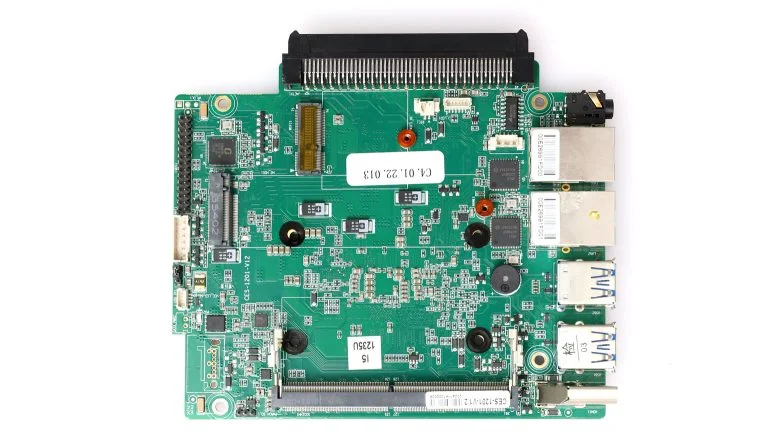
By adopting a 10-layer motherboard design, CESIPC ensures:
- Lower field failure rates
- Improved long-term operational stability
- Reduced maintenance costs for system integrators
- Better performance consistency in harsh environments
Application Scenarios
CESIPC 10-layer industrial PCs are widely used in:
- Industrial automation systems
- CNC machine control platforms
- Machine vision inspection systems
- Smart manufacturing (Industry 4.0)
- MES and factory data acquisition systems
- Edge computing gateways
In these environments, system reliability is more critical than raw computing power.
Conclusion
In industrial computing, reliability is not an option—it is the foundation of system design.
CESIPC’s 10-layer motherboard architecture reflects a deliberate engineering choice focused on signal integrity, power stability, and industrial-grade durability.
By increasing internal design complexity, CESIPC ensures simpler outcomes for customers: stable operation, lower downtime, and predictable performance in real industrial environments.
Talk to a CESIPC Engineer
Our application engineers are ready to help you select the right configuration, discuss ODM requirements, or provide a tailored quotation for your project.
Typical response within 24 hours · Multilingual support · CE / FCC / BIS compliant


We use your details only to answer this enquiry — no newsletters, no sharing. Drawings or a photo of the existing panel can be sent to sales@cesipc.com.