
Project background

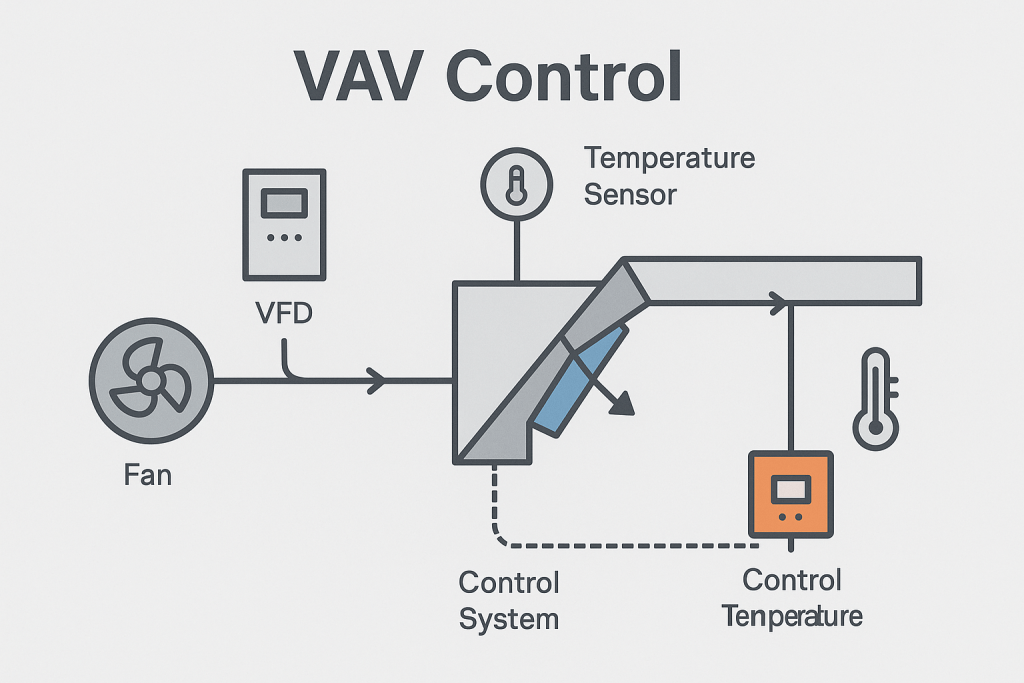
In a large smart building project, the client adopted a VAV (Variable Air Volume) control system to manage heating, ventilation and air conditioning efficiently, zone by zone, instead of conditioning the whole floor at one setpoint.
The terminal for that system had to live inside the project’s electrical control cabinet and run 24/7 without an operator in the room. It needed to be more than a screen: a control terminal with industrial reliability, enough serial and Ethernet ports for the buses already installed in the building, and enough compute to keep real-time data moving between the zones.
The requirement
The project team specified five conditions before any hardware was quoted:
- 24/7 continuous operation — an HVAC system cannot wait for a terminal to be rebooted or replaced.
- Cabinet-door mounting — the unit had to be let into a cutout in the control cabinet, not sit on a desk or a shelf.
- Serial and Ethernet in one unit — VAV boxes, temperature sensors and variable frequency drives (VFDs) do not all sit on the same bus.
- A fanless enclosure — plant rooms are dusty, and no one is going to service a filter on a monthly schedule.
- A platform that stays orderable — the same cutout has to accept a faster build later, without touching the cabinet door again.
The solution: EPC-S1222A on the EPC-S12X2A platform
The EPC-S1222A Industrial Panel PC was selected as the core VAV Control Panel PC. It is the 12th Gen Core build of the EPC-S12X2A 12-inch fanless panel PC family, in which display, cutout, mechanics and port count are shared across every build — only processor, memory and storage change. That is what makes the last requirement above meetable: a faster compute board can be swapped into the same 277.9 × 222.7 mm opening three years from now.
From that one screen at the cabinet door, the operator monitors and controls air volume, temperature and sensor data across multiple zones.
Delivered configuration:
| Item | Delivered specification |
|---|---|
| Model | EPC-S1222A — 12th Gen Core build of the EPC-S12X2A family |
| Display | 12-inch 4:3 TFT LCD, 1024 × 768 XGA, 300 cd/m², 500:1 |
| Touch | Projected-capacitive multi-touch (5-wire resistive on request) |
| Processor | Intel® Core™ i5-1235U (i3-1215U and i7-1250U also orderable on the same chassis) |
| Memory | 8 GB DDR5 (up to 32 GB) |
| Storage | 256 GB M.2 SSD, second M.2 slot free |
| Serial ports | 2 × RS-232 + 1 × RS-485 (DB9) |
| USB | 6 × USB Type-A (5 × USB 2.0 + 1 × USB 3.0) |
| Networking | 2 × Intel I210 Gigabit Ethernet |
| Video & audio | 1 × HDMI, 1 × VGA, 1 × 3.5 mm audio |
| Cooling | Fanless — aluminium housing acts as the heatsink |
| Front panel protection | IP65 |
| Mounting | Panel mount, 277.9 × 222.7 mm cutout · wall mount and VESA also supported |
| Dimensions / weight | 299.0 × 237.5 × 74.6 mm / 2.91 kg |
| Power | 12 V DC via 3-pin pluggable terminal block (9–36 V DC optional) |
| Operating system | Windows 10 / 11 (Windows 7 and Ubuntu 16.04–22.04 also supported) |
| Reliability | MTBF 60,000 h · SafeCore™ power-loss protection with automatic power-on recovery |
| Operating temperature | 0–50 °C standard · −40–70 °C optional |
How the terminal talks to the VAV system
- The two Gigabit Ethernet ports are used separately: one on the building automation network for BACnet/IP, one on a control subnet for the panel’s own devices and diagnostics.
- The RS-485 port carries Modbus RTU to the VAV boxes and VFDs that only speak serial.
- The two RS-232 ports cover legacy controllers that were never moved onto a bus, plus a commissioning laptop when an engineer is on site.
- The terminal runs the building automation software for data acquisition, trend analysis and alarm management, with Modbus TCP alongside BACnet/IP, and remote monitoring and cloud synchronisation so the facilities team can see the zones without driving to the plant room.
Results
Once the terminal was commissioned, the project reported:
- Up to 25% energy savings through zone-based air volume regulation;
- 40% faster system response, which improved occupant comfort on the floors served;
- 24/7 operation for more than 12 months without a failure — the unit is still in service.
Why the platform holds up in an unattended plant room
- Fanless by construction. A fan pulls the dust and oil mist of a plant room through the electronics; this unit has no fan and no filter, and sheds heat through its aluminium housing at a 60,000-hour MTBF.
- SafeCore™ power-loss protection. After an unexpected power cut the system state is preserved and the unit powers on by itself — the difference between a control system that resumes and one that waits for a site visit.
- IP65 front panel. The operator side is sealed against dust and washdown, which matters at a cabinet that opens onto a service corridor or a plant room.
- Upgradeable without re-cutting the cabinet. BlockCore™ board-to-board architecture lets the compute board be swapped, and i-Door function cards add CAN bus, extra LAN, isolated serial or 4G LTE to the same chassis.
- Cutout that fits a standard cabinet door. 277.9 × 222.7 mm opening, 74.6 mm of depth behind the panel — no separate monitor cable run, no box PC on a shelf inside the cabinet.
- Orderable and supported. Ships within 7 days, with local technical support in Southeast Asia and Europe.
Related pages
- EPC-S12X2A 12-inch fanless industrial panel PC — the platform this case was built on, with the full family specification and cutout drawing.
- EPC-S1222A Industrial Panel PC — the 12th Gen Core configuration supplied here.
- CTN-1262D building automation panel PC — the alternative when a plant room needs six isolated RS-485 trunks instead of one.
- More CESIPC success stories and application notes.
Contact CESIPC Team


We use your details only to answer this enquiry — no newsletters, no sharing. Drawings or a photo of the existing panel can be sent to sales@cesipc.com.