





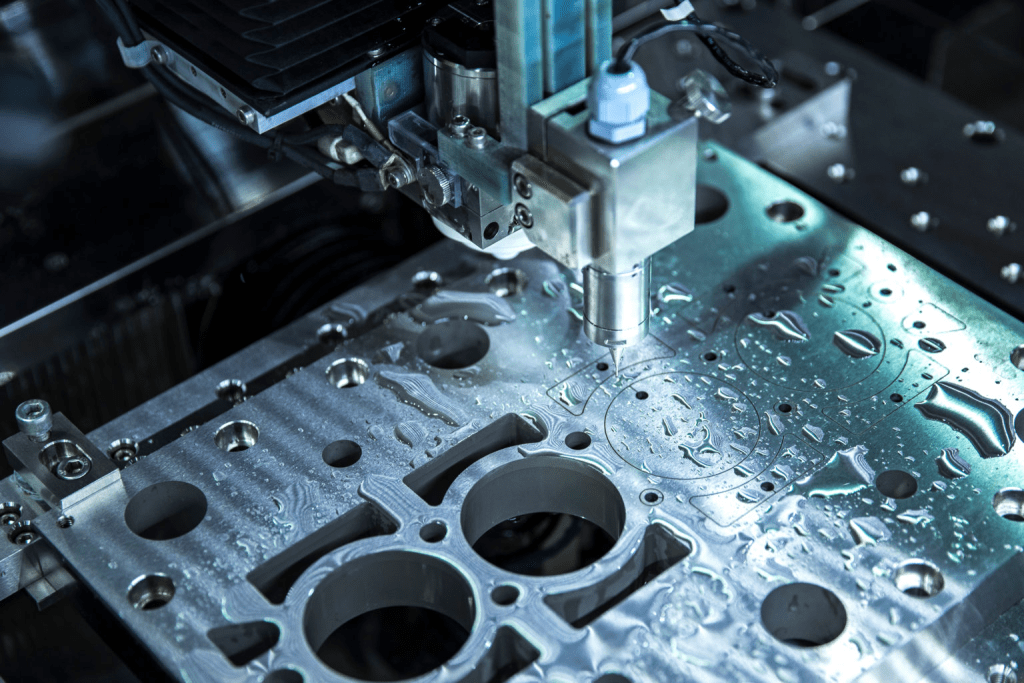
Metal fabrication is one of the most demanding environments for CNC equipment. Between flying chips, coolant mist, electromagnetic interference from servo drives, and the relentless pressure of tight tolerances, every component in your CNC system is put to the test — including the brain behind it all: the Industrial PC (IPC).
This article walks through what operators, engineers, and machine builders should monitor in a CNC metal fabrication setup. But first, we want to challenge a common assumption about IPC selection that our own testing has disproved.
The Counterintuitive Truth: Why CESIPC Uses Intel i3 — Not i5 or i7
When people spec an IPC for CNC control, the instinct is to go for the highest-performance processor available. More cores, higher clock speeds, better benchmark scores. It seems logical.
Our internal testing told a different story. This is based on CESIPC client, the Europe CNC controller:
CESIPC’s CNC-optimized IPCs run on the Intel Core i3-10110U — and that’s a deliberate engineering decision, not a cost-cutting measure.
Here’s why: CNC motion control depends on a steady, consistent stream of pulse signals to drive servo motors and stepper axes. Any irregularity in that pulse output — even microsecond-level variation — shows up as axis jitter: small, erratic deviations in tool path that degrade surface finish and dimensional accuracy.
The culprit in higher-end processors is dynamic frequency scaling (Intel Turbo Boost). When an i5 or i7 detects available headroom, it automatically ramps its clock speed — from a base of, say, 2.4 GHz up to 4.5 GHz or higher. This frequency jump is nearly instantaneous, but it creates timing inconsistency on the system bus, which propagates directly into pulse signal irregularity.
The i3-10110U operates at a stable, controlled frequency without aggressive Turbo Boost behavior. The result: pulse output that is measurably more uniform, and CNC axes that run smoother.
In CNC control, what matters is not peak processing power — it’s clock stability over time. An i3 that runs consistently at 2.1 GHz outperforms an i7 that fluctuates between 1.8 and 4.7 GHz, every time.
This is the kind of insight that only comes from testing in real CNC environments — not from reading processor spec sheets.
What Else to Monitor in CNC Metal Fabrication
With that foundation in mind, here’s what to watch across your CNC setup:
1. Pulse Signal Integrity
The quality of the pulse stream from your IPC to the servo drives is the single most important variable in axis precision. Signs of pulse jitter include:
- Subtle surface finish irregularities at consistent feed rates
- Axis positioning that passes inspection in isolation but drifts in continuous operation
- Servo alarm codes that appear intermittently without mechanical cause
If you’re seeing any of these, the issue may not be your servo drive or motor — it may be your computing platform.
2. Spindle and Tooling Condition
- RPM consistency — fluctuations indicate bearing wear or electrical instability
- Tool runout — even 0.01mm can ruin a tight-tolerance part in steel or titanium
- Tool wear patterns — stainless work-hardens, aluminum builds up on cutting edges, titanium generates extreme heat
3. Thermal Environment
Long continuous runs cause thermal expansion in both the workpiece and machine structure. Inside the electrical cabinet, heat also affects IPC behavior — which is why a fanless, wide-temperature-range IPC design is far more appropriate than commercial-grade hardware that may throttle under load.
4. Cutting Parameters
| Parameter | What it affects |
|---|---|
| Cutting speed (m/min) | Tool life, heat generation |
| Feed rate (mm/rev) | Surface finish, chip formation |
| Depth of cut | Spindle load, vibration |
| Coolant flow & concentration | Thermal control, chip evacuation |
5. Vibration and Chip Management
Metal chips are conductive and sharp. Vibration during aggressive cuts can loosen workholding and introduce mechanical noise into the control system. Your IPC should be sealed against chip ingress and electrically isolated from servo-drive interference in the cabinet.
Why the IPC Platform Is the Variable Most People Overlook
Most CNC troubleshooting focuses on the cutting tool, the servo drive, or the G-code. The IPC is rarely questioned — until pulse jitter, communication dropouts, or unexpected reboots appear.
CESIPC has been building industrial computing platforms for CNC applications since 2009. The choice of the i3-10110U reflects a broader design philosophy: in CNC control, stability and determinism matter more than raw performance. This principle carries through every aspect of CESIPC’s IPC design — from EMC-hardened board layout, to single-side I/O for clean cabinet wiring, to platform version freeze for long-term validated deployments.
For CNC solution vendors, this means a hardware platform that can be locked at a verified configuration and trusted to behave consistently across production runs and machine generations.
For machine tool builders, CESIPC Panel PCs serve as operator HMI terminals while IPCs handle control, data acquisition, and MES connectivity — engineered to work together.
Conclusion
In CNC metal fabrication, precision starts long before the tool meets the metal. It starts with the pulse signal leaving your IPC.
If you’re evaluating industrial computing platforms for CNC applications, don’t just compare processor benchmarks. Ask how the platform behaves under continuous real-time control loads — and whether its clock behavior is optimized for pulse consistency, not peak throughput.
Explore CESIPC’s IPC and Panel PC solutions for CNC applications → cesipc.com/applications/cnc-systems-explained
CESIPC (Cloud Embedded Technology Co., Ltd.) — Industrial PC manufacturer based in Shenzhen, China. 16 years of experience in industrial computing for CNC, manufacturing, energy, and more.


