





–Episode 6–
When people talk about CNC, the conversation often stays on the surface: “How expensive is the machine?” “How tight is the tolerance?” “Is the control system FANUC or Siemens?”
But once CNC is used on a real shop floor, the question that matters more is this:
Who uses CNC, what do they use it for, and why can’t other processes replace it?
The core value of CNC machining is simple:
CNC delivers repeatable, controlled, and traceable manufacturing results—at scale.
That’s why CNC has become “non-negotiable” across so many industries.
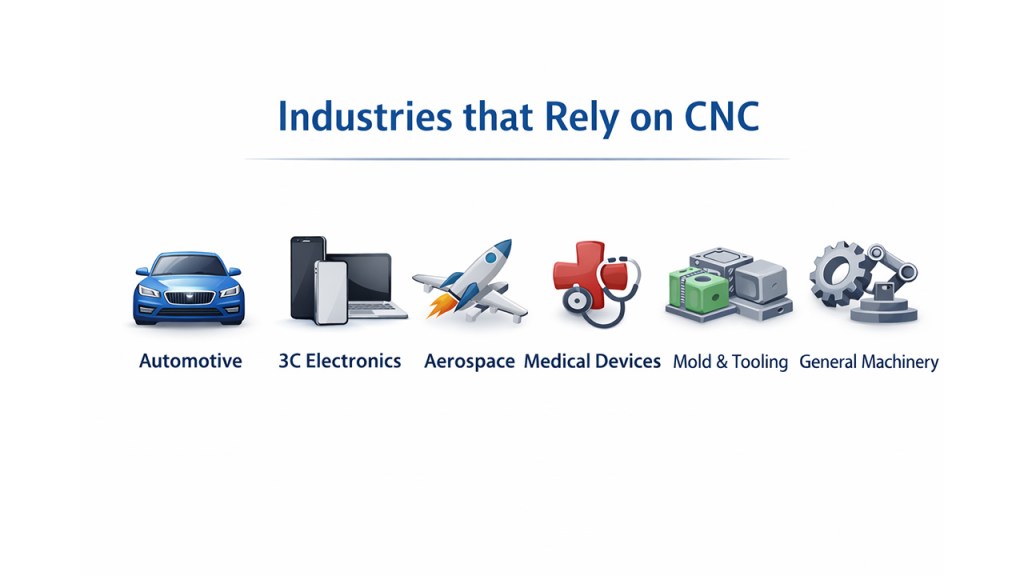
1) Automotive & Auto Parts: High Volume, Consistency Is the Baseline
In automotive manufacturing, the goal isn’t just to make a part once—it’s to make it the same way, every time, across thousands (or millions) of cycles.
Typical CNC applications include:
- Engine blocks, cylinder heads, transmission housings: multi-face machining, complex datum chains, tight hole-position accuracy
- Steering knuckles, hubs, braking components: high-strength materials, safety-critical performance, strict quality requirements
- Jigs, fixtures, gauges: often overlooked, but they’re the infrastructure that keeps mass production stable
Automotive relies on CNC because it protects the production line: takt time, yield rate, and traceability. In mass production, rework isn’t just “extra time”—it can disrupt the rhythm of the entire line.
SEO keywords: CNC machining for automotive, CNC auto parts manufacturing, engine block CNC machining
2) 3C Electronics: Small, Thin, Fast—And Cosmetic Parts Are Brutal
Phones, laptops, wearables, and consumer electronics depend on CNC for both structure and appearance.
Common CNC-machined parts:
- Aluminum/magnesium housings: thin walls that deform easily, demanding toolpath + fixturing expertise
- Camera brackets, heat sinks, internal frames: tiny parts, but precision is non-negotiable
- Prototyping fixtures and tooling: frequent model refresh cycles require fast iteration
3C chooses CNC for one main reason: speed with flexibility. From design change → prototype → pilot run, CNC is the process that can keep up without rebuilding an entire production route.
SEO keywords: CNC machining for electronics, CNC aluminum housing, rapid CNC prototyping
3) Aerospace: Tough Materials, Complex Geometry, Zero Excuses
Aerospace machining demands more than capability—it demands process discipline.
Why CNC is essential here:
- Titanium & superalloys: narrow cutting windows, high tool wear, sensitive thermal behavior
- Thin-wall and complex surfaces: multi-axis (especially 5-axis) machining is often the only practical option
- Strict compliance and traceability: every step must be documented, repeatable, and auditable
In aerospace, CNC isn’t just about “making the part”—it’s about proving the process.
SEO keywords: aerospace CNC machining, 5-axis CNC aerospace, titanium CNC machining
4) Medical Devices: Precision + Small Batches + High Compliance
Medical manufacturing often combines the worst (and best) of all worlds: tight tolerances, complex standards, and varied production volumes.
Typical CNC use cases:
- Orthopedic implants and dental components: titanium, stainless steel, cobalt-chrome; surface finish matters
- Surgical instruments: burr control, chamfers, edge quality, and fitment are critical
- Customization trend: more patient-specific, low-volume, high-mix production
Medical device makers rely on CNC not only for accuracy, but for consistency and process control—because every part has consequences.
SEO keywords: medical CNC machining, CNC machining implants, precision CNC medical parts
5) Mold & Tooling: CNC Is the Main Production Engine
Mold making is the foundation of manufacturing, and CNC is the workhorse that builds that foundation.
Where CNC dominates:
- Injection molds, die casting molds, stamping dies: cavities, parting lines, inserts, core components
- Electrode machining for EDM: CNC quality directly impacts EDM efficiency and rework risk
- Tight deadlines: a delayed mold can delay an entire downstream production launch
Tooling shops value CNC not for “extreme specs,” but for reliability, uptime, and low error rates.
SEO keywords: CNC machining for molds, mold CNC machining, CNC electrode manufacturing
6) General Machinery & Industrial Equipment: The Universal CNC Zone
If it’s a mechanical structure, motion part, or assembly component, there’s a good chance CNC touches it.
Examples include:
- Flanges, brackets, mounting plates, housings
- Shafts, bushings, sleeves, gear-related components
- Automation parts (grippers, rails, sliders, fixtures, bases)
These industries deal with high mix, variable demand, and experience-driven process planning. CNC becomes the “universal platform” because it can handle variety without losing control.
SEO keywords: industrial CNC machining, CNC machining parts, CNC for automation equipment
A Practical Rule: What Kind of Product “Can’t Avoid” CNC?
If your product hits two or more of these conditions, CNC is usually hard to replace:
- You must deliver stable dimensional consistency
- The geometry is complex (multi-face, hole patterns, contours, surfaces)
- The material is difficult to machine (hard, tough, sticky, heat-sensitive)
- Lead time and iteration speed matter
CNC is everywhere not because it’s “cool,” but because it’s dependable.
Why It’s Not Just the Machine Tool: Stable CNC Needs a Stable Industrial Computing Platform
In real production, “CNC capability” isn’t only about the spindle and the controller. Long-term reliability depends on the system around it: HMI, data collection, process logging, alarms, traceability, and integration with MES/SCADA/production lines.
That’s where industrial computing becomes essential—and why many factories choose platforms like CESIPC industrial PCs (Panel PCs / Industrial Computers) for CNC environments. These systems are designed for shop-floor realities: EMI resistance, dust/heat tolerance, 24/7 uptime, long lifecycle supply, and stable deployment.
CNC ensures the cut is right.
A solid industrial PC ensures the operation stays visible, manageable, and traceable—day after day.
Contact CESIPC Team


