
An industrial PC with PoE simplifies camera integration in automated inspection systems by carrying power and image data to compatible cameras over one cable.
On the CESIPC EPC-102B, two 802.3at ports deliver 30 W each — 60 W in total — so no camera needs a power drop at its mounting position.

Two cameras, two Ethernet cables, no power drop at the camera — EPC-102B with PoE.
01How Does an Industrial PC with PoE Support Automated Inspection?
An automated inspection system has four parts: industrial cameras, an industrial computer, inspection software and a machine controller. The cameras capture product on the line, the software judges it against defined criteria, and the result goes to the controller for sorting or rejection.
PoE changes the wiring between those parts — and the wiring is where the cost sits. Without it, every camera needs its own power drop: a supply, a fuse, a cable, a gland, and one more terminal in a cabinet that may have no room left.
One cable instead of two. On a moving gantry or through a cable chain, the second cable is another run to route, clamp and protect — and another place to break.
Camera traffic off the control network. Four independent Intel I210 ports let the camera pair sit on its own segment while the controller and the factory network keep their own rules — with no managed switch in the cabinet.
Simpler spares and commissioning. One cable type, one connector type, one spare. Swapping a failed camera is unplug and replug.
02CESIPC EPC-102B: An Industrial PC with Dual PoE LAN
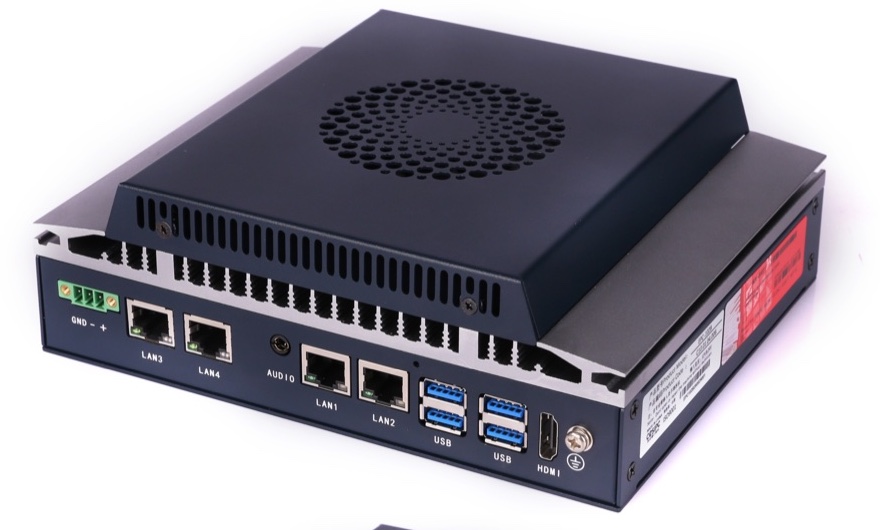
A compact fanless box PC for automation. Its updated configuration adds PoE on LAN1 and LAN2 — two power-sourcing ports for compatible cameras — while keeping four independent Gigabit LAN ports for cameras, controllers and factory systems.
| Dual PoE LAN | 802.3at Type 2, 30 W per port, 60 W total, backwards compatible with 802.3af cameras. LAN3 and LAN4 carry no PoE. |
| Four Gigabit LAN | Four Intel I210 controllers — cameras, machine controllers and factory systems stay on separate segments. |
| 12th Gen Core | i3-1215U, i5-1235U or i7-1255U, matched to the inspection workload. |
| Modular I/O | RS-232/422/485, digital I/O and CAN bus as BlockCore® function cards. |
| Industrial build | 337 × 160 × 47.5 mm milled aluminium, about 2 kg, passively fanless with automatic fan assist, 9–3624 V DC input, 0–50 °C standard. |
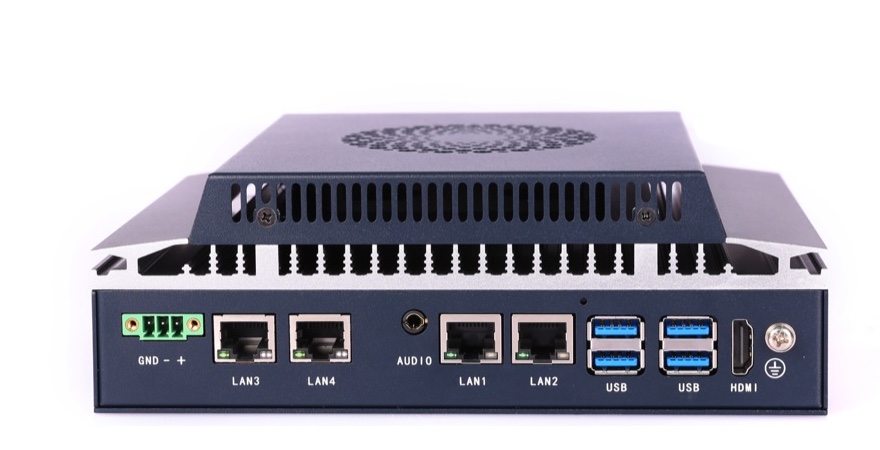
PoE specification and scope
Ports: LAN1 and LAN2 only — four LAN ports does not mean four PoE ports.
Standard: 802.3at Type 2 (PoE+), 30 W per port, 60 W total.
Direction: source only (PSE); no PoE input on the box.
Input: full PoE load needs a 24 V supply.
03Automated Inspection Applications Across Different Industries
The wiring argument is the same in every case; what changes is why it matters on that line.
Food and agricultural sorting
Vision inspects chillies, fruit and vegetables for defects and discolouration; a sorting controller fires the air jet.
Washdown side is where it pays
Electronics and component inspection
Automated optical inspection checks placement, solder joints and surface condition at high throughput.
Frees space in a packed enclosure
Automotive parts inspection
Surface defects, component positions and assembly conditions, often checked with cameras on moving equipment.
One cable through the chain
Packaging and label inspection
Label position, print quality and product identification, checked as the pack leaves the line.
Two cameras, two ports
Logistics and parcel sorting
Barcode reading and sort decisions at read points and reading tunnels.
Camera count drives the design
Two PoE ports cover one station, not a whole line. Beyond two cameras, use an external PoE switch or a platform with more ports — the CESIPC EA-N500, on NVIDIA Jetson Orin NX, provides four and adds on-board inference for lines that classify at the camera.
04What to Consider When Choosing an Industrial PC with PoE
| PoE budget | 30 W per port, 60 W across both. Two cameras fit; a third needs an external switch. A 30 W port rating does not by itself mean two cameras run at 30 W each. |
| Camera figures | Datasheets quote the device side (12.95 W / 25.5 W), not the port side (15.4 W / 30 W) — a 25.5 W camera uses the whole port. |
| Compute | Match CPU, memory and storage to the number of streams and the image-processing workload. |
| Machine communication | Serial, digital I/O or CAN — function cards on this platform, not a different chassis. |
| Environment | Ambient temperature, enclosure, ventilation. 60 W of PoE output is about 60 W of extra heat inside the box. |
The DC supply is the ceiling that catches people out. PoE is generated inside the box from the same input as the motherboard, so 60 W at the ports costs about 67 W at the input before the system’s own draw — which is why a 24 V supply is required. A 3-pin terminal is rated around 5–7 A per pin, and cabinet wiring adds its own limit on top.
| On the two PoE ports | PoE sourced | Supply to fit | Will 12 V work? |
|---|---|---|---|
| 1 × 802.3at camera (≤ 30 W) | up to 30 W | 24 V / 5 A | No — 6.6 A |
| 2 × 802.3af cameras (≤ 15.4 W each) | up to 30.8 W | 24 V / 5 A | No — 6.6 A |
| 2 × 802.3at cameras (≤ 30 W each) | up to 60 W | 24 V / 8 A | No — 9.3 A |
Assumes ≈45 W system draw on a mid-range 12th Gen Core build and 90 % PoE conversion efficiency. Rule of thumb: (system draw + PoE output ÷ 0.9) × 1.25. With no PoE device fitted, the box alone runs from 12 V.
Built-in ports or an external PoE switch? Built-in for one or two cameras, where space is short and the camera subnet should stay off the plant network. An external switch for three or more, for per-port control, or for any budget above 60 W.
For washdown or direct water exposure, the EPC-102B must go inside a protected enclosure — it is not a washdown-rated computer. On a washdown line the pattern is the box PC in the stainless cabinet and an IP69K panel PC at the operator position.
05Frequently Asked Questions
What is an industrial PC with PoE?+
How many PoE cameras can the EPC-102B power?+
Do all four LAN ports provide PoE?+
Does the EPC-102B receive power over Ethernet, or supply it?+
What is the difference between 802.3af and 802.3at?+
Can I run the EPC-102B from 12 V with two PoE cameras?+
Built-in PoE ports or an external PoE switch?+
Which CESIPC models offer PoE, and how do they differ?+
Can CESIPC confirm that my cameras will work with the EPC-102B?+
What should I prepare before requesting a PoE configuration from CESIPC?+
06Explore the CESIPC EPC-102B Industrial PC
Four Gigabit LAN ports, 802.3at PoE on LAN1 and LAN2, three 12th Gen Core options and modular industrial I/O. Send the camera list, the cable lengths and the cabinet supply voltage, and CESIPC can confirm the port allocation, the DC supply and the I/O before anything is ordered.
EPC-102B with dual PoE LAN
30 W per port · 60 W total · IEEE 802.3at PoE+
Related reading