
___2026.06.24
Multi-Bridge, Multi-Device Collaborative Data Acquisition with CESIPC EPC-306C A Fanless Industrial PC
Project Overview
As airports continue to accelerate digital transformation, boarding bridges are no longer isolated infrastructure assets. They have become critical nodes in airport operational intelligence systems, requiring continuous communication with Airport Collaborative Decision-Making (ACDM) platforms.
This project demonstrates how the CESIPC EPC-306C Industrial Computer was deployed as the intelligent edge processing terminal in a domestic airport boarding bridge modernization project.
The solution enables:
- reliable multi-device data acquisition,
- real-time operational data transmission,
- and seamless integration with the airport’s ACDM system.

The result is improved operational visibility, reduced maintenance requirements, and enhanced collaborative decision-making across airport operations.
Challenges in Traditional Boarding Bridge Systems
Boarding bridges must continuously collect data from various field devices, including:
- Position sensors
- Status monitoring devices
- Safety control modules
- Mechanical control systems
The collected data must then be transmitted to the airport ACDM platform in real time to support:
- Boarding bridge scheduling
- Equipment status monitoring
- Operational analytics
- Fault detection and alerts
However, existing systems faced several challenges:

Limited Connectivity
Traditional embedded controllers often provide insufficient serial interfaces, making it difficult to connect multiple field devices simultaneously without additional expansion modules.
High Maintenance Costs
Many legacy systems rely on active cooling fans. In harsh airport environments, fan failures can lead to overheating, downtime, and interrupted data acquisition.
Data Transmission Delays
Operational data often experiences upload delays or packet loss, affecting the responsiveness of airport management platforms.
Space Constraints
Boarding bridge equipment rooms provide limited installation space, making it difficult to deploy large industrial computers or additional expansion hardware.
CESIPC Solution

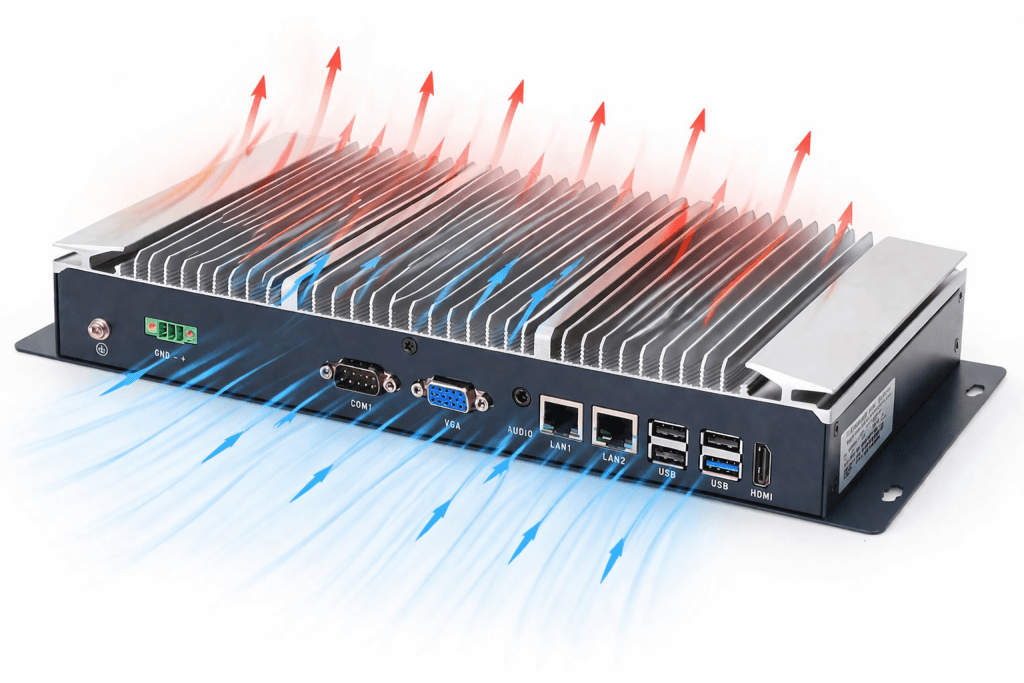
To address these challenges, each boarding bridge was equipped with a CESIPC EPC-306C fanless industrial computer, serving as the local edge computing and data acquisition hub.
Hardware Configuration
| Item | Specification |
|---|---|
| Processor | Intel® Celeron J1900 |
| TDP | 10W |
| Memory | 4GB RAM |
| Storage | 128GB SSD |
| Serial Ports | 4 × High-Speed RS-485 |
| Max Baud Rate | Up to 20 Mbps |
| Transmission Distance | Up to 1,219 meters |
| Cooling Design | Fanless |
| Installation | Compact Industrial Chassis |
Key Advantages
1. Reliable Multi-Device Data Acquisition
The EPC-306C connects directly to multiple sensors and control modules through four high-speed RS-485 interfaces.
Benefits include:
- Simultaneous acquisition from multiple field devices
- Elimination of additional serial expansion modules
- Reduced wiring complexity
- Improved system reliability
Its RS-485 interfaces provide strong common-mode noise immunity, ensuring stable communication within the complex electromagnetic environment of airport boarding bridges.
2. Fanless 24/7 Operation
Powered by the low-power Intel J1900 processor, the EPC-306C operates without cooling fans.
Advantages include:
- Lower failure rates
- Reduced maintenance requirements
- Silent operation
- Continuous 24/7 data collection
The fanless design is particularly valuable in unattended equipment rooms where long-term reliability is essential.
3. Real-Time ACDM Data Integration
The combination of 4GB memory and 128GB SSD storage enables real-time processing of operational data collected from multiple devices.
The EPC-306C continuously uploads data to the airport ACDM platform, supporting:
- Real-time boarding bridge status monitoring
- Collaborative scheduling
- Operational decision support
- Event and anomaly reporting
This ensures that airport management systems receive accurate and timely operational information.
4. Fast Deployment and System Compatibility
The solution integrates directly with existing boarding bridge infrastructure and is compatible with mainstream airport management platforms, including ACDM systems.
Benefits include:
- Minimal changes to existing equipment
- Reduced deployment time
- Lower project implementation costs
- Smooth migration from legacy systems
Project Results
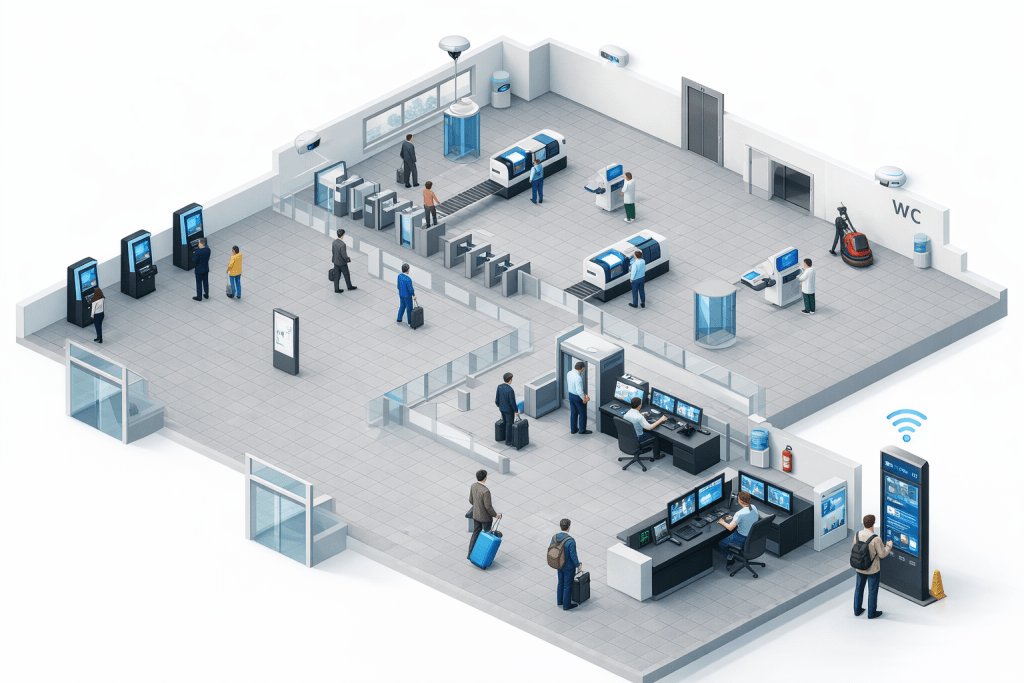
Following deployment, the airport achieved significant improvements in operational performance.
| Performance Indicator | Before Upgrade | After Upgrade |
|---|---|---|
| Data Acquisition Interruption Rate | 12% | 0% |
| Manual Maintenance Frequency | High | Reduced by 6 interventions per month |
| Boarding Bridge Scheduling Efficiency | Baseline | Improved by approximately 30% |
| Data Packet Loss | Present | 0% |
The project successfully established seamless data collaboration between boarding bridge equipment and the airport ACDM platform.
Airport operators can now monitor the status of every boarding bridge in real time, enabling faster decision-making and more efficient resource allocation.
Recommended Applications
The CESIPC EPC-306C is ideal for:
New Airport Boarding Bridge Projects
Deploy intelligent edge computing capabilities from the beginning of system construction.
Boarding Bridge Modernization Projects
Upgrade existing boarding bridge control systems without extensive infrastructure changes.
Airport ACDM Integration
Enable reliable data exchange between boarding bridge equipment and airport operational management platforms.
Smart Airport Infrastructure
Support digital transformation initiatives that require real-time equipment monitoring and operational intelligence.
Conclusion
As airports continue to pursue smarter and more connected operations, reliable edge computing infrastructure becomes increasingly important.
The CESIPC EPC-306C provides a compact, fanless, and highly reliable platform for boarding bridge data acquisition and ACDM integration. With robust industrial communication capabilities, low power consumption, and long-term operational stability, it helps airports improve efficiency, reduce maintenance costs, and build a stronger foundation for future smart airport initiatives.
Talk to a CESIPC Engineer
Our application engineers are ready to help you select the right configuration, discuss ODM requirements, or provide a tailored quotation for your project.
Typical response within 24 hours · Multilingual support · CE / FCC / BIS compliant

