
Last updated: 28 October 2026
Australian dairy plants are judged on hygiene before they are judged on automation. Every surface inside the production area has to stay cleanable, every cleaning cycle has to be repeatable, and the equipment that sits on the line has to survive that regime for years. This page records how a hygienic panel PC was applied on Australian dairy lines, what the hygiene requirement actually demands of the enclosure, and which stainless units are running on site. It is built entirely from CESIPC’s own record of the installation.
Why hygiene, not waterproofing, is the real requirement
Water resistance is a consequence, not the objective. The Australian dairy industry works to strict hygiene standards, including defined hygiene control points and critical control points, so that the production environment stays clean and verifiable. The failure modes the audits are written against are cross-contamination and food-safety incidents, and the control is a rigorous cleaning and disinfection procedure that runs on a fixed schedule.
That changes the question a panel PC has to answer. It is not “will it get wet?” but “what does the cleaning cycle do to it, and what does it leave behind?” Detergent, hot water and a hose reach the front face, the seams, the cable entry and the bracket. A hygienic panel PC is the one where none of those points becomes a soil trap or a water path into the electronics.
What a hygienic panel PC has to survive
CESIPC stainless panel PCs are rated between IP65 and IP69K depending on the unit and the cleaning regime, and they are built on industrial-grade components with a fanless design so they keep running in wet, harsh areas. In practice that means the unit survives the routine cleaning cycle, cleaning agents and water together, without letting contaminants into the production environment. Which rating a station needs is decided by the cleaning action rather than by the room: IP65, IP67 and IP69K test different things, and a nozzle on the end of a hose is not the same requirement as a wipe-down.
Stainless steel, sealed interfaces and no fan
- 304 stainless enclosure. The casing is corrosion-resistant and cleanable, with no painted mild steel hidden behind a front bezel to corrode first.
- Sealed aviation-plug I/O. Cable entry is where water usually wins. The interface block is sealed rather than an open port or a gland, and it can be unplugged for cleaning without exposing the electronics.
- Fanless. A fan pulls room air through the enclosure. On a dairy line that air carries dust, flour and cleaning aerosols, so the fan becomes both a contamination route and a maintenance item. With no air path through the box, there is nothing to clog and nothing to draw contaminants in.

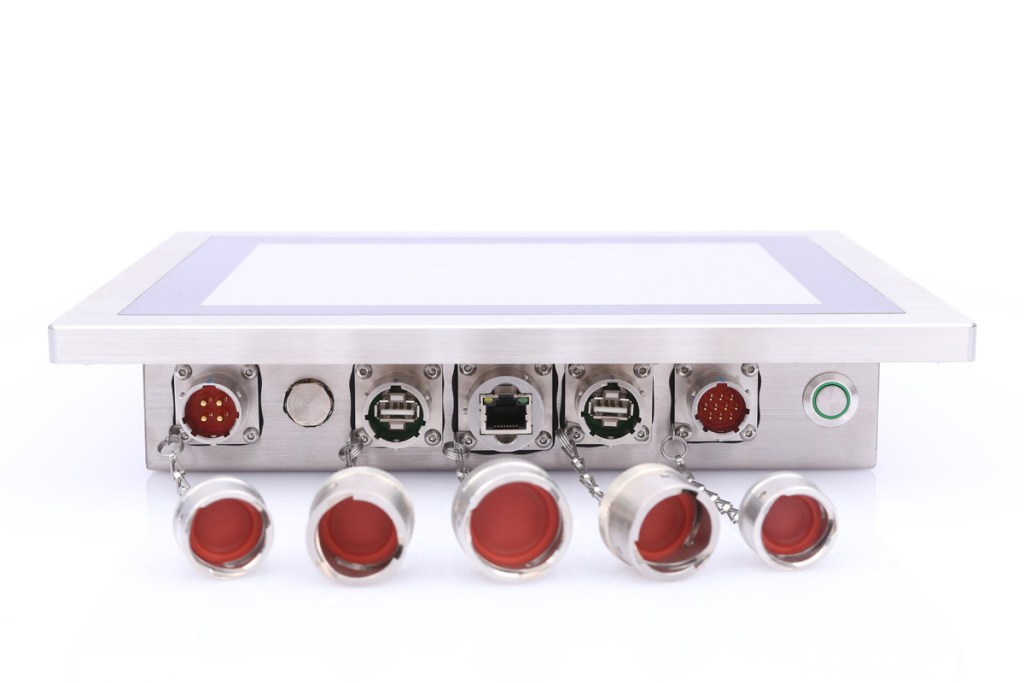
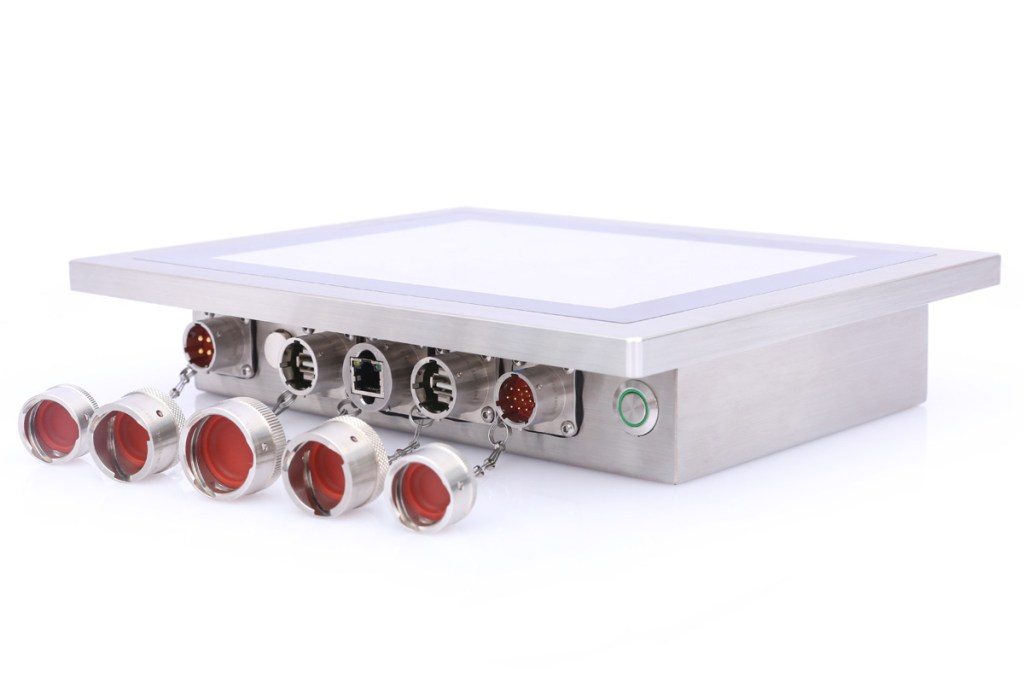
Three stainless units on Australian dairy lines
The series is already in service across Australian dairy processing facilities. Three units show the range of the approach: a small terminal, a mid-size station and a large-screen control point.
| Model | Screen | Enclosure | Rating | Processor | Notes |
|---|---|---|---|---|---|
| KLD-1061B | 10-inch | 304 stainless, fully sealed | IP65 | Intel Celeron J1900 | Five-wire resistive touch; operating range −10 °C to 60 °C |
| KLD-1561A | 15.6-inch | 304 stainless, fully sealed | IP66 | Intel Celeron J1900 | LED panel |
| KLD-2182GA | 21.5-inch | Fully sealed stainless | IP65 | Intel Core 7th-gen low power | Larger production areas and control points |
Where a plant mounts a screen into a stainless wall or a machine frame rather than on an arm, the embedded variant is the better fit: a flush-front stainless embedded panel PC keeps the bezel out of the cleaning path entirely.
Quality control is the other half of the hygienic requirement
Hygiene keeps the product safe; quality control proves it. Dairy facilities have to run effective quality-control systems that monitor the process and demonstrate that the product meets national and international quality standards. That is a computing job, and it is the reason a hygienic panel PC cannot be a sealed box with no headroom: it needs stable processing power for data collection and monitoring while it sits inside the washdown zone.
CESIPC specifies the processor against that workload, with corrosion-resistant 304 stainless casings and sealed aviation-plug I/O so the unit stays durable where a standard panel PC would not. Food and beverage plants generally, not only dairies, run into the same combination — see industrial computing in food and beverage for the wider picture.
Field evidence from Australian dairy plants

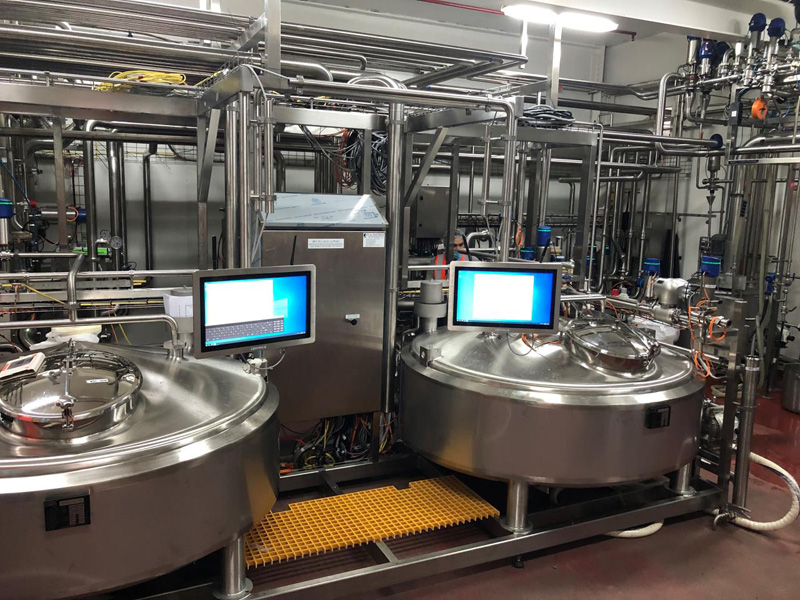
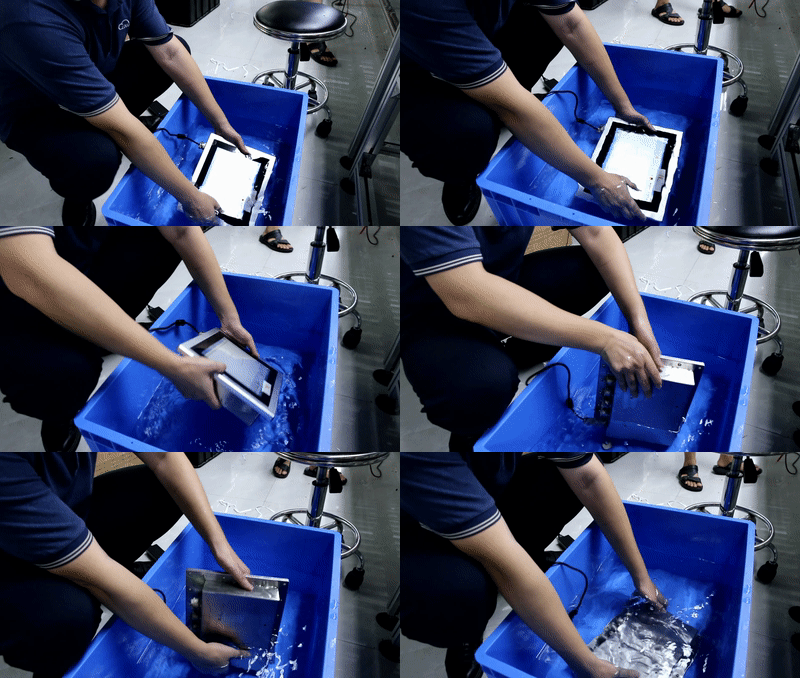

Hygienic panel PC questions from dairy projects
What makes a panel PC hygienic rather than just waterproof?
A hygienic panel PC is cleanable, not only water-resistant. CESIPC stainless units combine a sealed fanless enclosure, a smooth 304 stainless front and sealed connector interfaces, so cleaning agents and water cannot carry contaminants into the electronics or leave soil traps on the surface.
Which IP rating should a dairy washdown area specify?
It depends on the cleaning action, not the room. Wipe-down lines are covered by IP65, a low-pressure hose rinse by IP65 or IP67, and a nozzle or high-pressure washdown needs IP69K. CESIPC rates these stainless panel PCs from IP65 to IP69K so the rating can follow the SOP.
Why does a fanless design matter for hygiene?
A fan pulls room air through the enclosure. On a dairy line that air carries dust, flour and cleaning aerosols, so the fan becomes both a contamination route and a maintenance item. CESIPC fanless panel PCs have no air path through the electronics, which suits hygienic areas.
What do the KLD models used in Australian dairy plants specify?
The KLD-1061B is a 10-inch 304 stainless unit rated IP65 with a five-wire resistive touchscreen and a −10 °C to 60 °C range. The KLD-1561A is a 15.6-inch IP66 unit, and the KLD-2182GA is a 21.5-inch IP65 model for larger production areas.
Does a stainless enclosure alone make a panel PC hygienic?
No. Stainless is what makes the surface cleanable and corrosion-resistant; the sealing and the rating decide whether the electronics survive. CESIPC specifies both on the same unit, because a 304 casing with an unsealed connector still fails on a washdown line.
How does cross-contamination happen at a control panel?
Three routes matter: soil left in crevices around bezels and buttons, water driven past unsealed connectors, and air drawn in by a fan. CESIPC addresses them with a crevice-free front, sealed aviation-plug I/O and a fanless enclosure rather than only a higher IP number.
Can a hygienic panel PC still run quality-control and MES software?
Yes. Dairy plants need stable processing power for data collection, monitoring and traceability, and the hygienic requirement does not remove that. CESIPC matches the processor to the workload, from J1900-class terminals to low-power Core processors for larger stations.
Which standards are quoted for these hygienic installations?
This page reports what CESIPC publishes: IP65, IP66, IP67 and IP69K ratings on the units listed, defined under the IEC 60529 and DIN 40050-9 hose and jet tests. Where a project names a certification we have not published for a specific model, treat it as unpublished and confirm it with our team.
Is IP69K always better than IP67 for dairy equipment?
Not always. IP69K covers a hot, high-pressure jet from four angles, which is what a washdown hose delivers. If the line is cleaned by wipe-down or a low-pressure rinse, IP65 or IP67 is sufficient, and CESIPC will say so rather than uprate the specification.
How do we confirm the right configuration for our plant?
Send the cleaning SOP, the mounting arrangement and the I/O list. CESIPC will confirm the enclosure, the rating, the connector set and the processor for that station, then quote build and lead time from the existing stainless platform.
Scope of this page
What this page is based on. Everything above comes from CESIPC’s own record of this Australian dairy installation and from the IP rating standards cited. Figures that have not been published for this project, such as the number of units on site, the cleaning chemistry in use or a measured failure rate, are deliberately left out rather than estimated. Ratings and processor options are as published for each unit; confirm the current revision with CESIPC before specifying.
Related reading: a 21.5-inch IP67 panel PC in a Vietnam meat plant, proven IP67 and IP69K units in food processing, and what each IP rating actually tests.