



CNC Systems Explained: From Numerical Control Architecture to Industrial PC Integration
The world’s first CNC—more precisely, NC (Numerical Control)—machine was developed in 1952 in the United States.
It was the first NC milling machine.
Key characteristics:
- Controlled by punch tape
- Machine motion driven strictly by coordinate-based instructions
- No manual feed involved
This moment is widely recognized as:
The first time in history that humans used “digital data” to directly control machine tool motion.
That is why CNC is regarded as the foundation of modern manufacturing.


Modern CNC Machine Comprises:
① Complete machine tool structure
├── Machine Bed
├── Guideways
├── Ball Screws
├── Spindle
└── Tool Magazine (ATC)
② Numerical control system
├── Interpolation
├── Coordinate Systems
├── Servo Control
├── Error Compensation
└── Control System Philosophy
③ Machining processes
├── Turning / Milling
├── Multi-Axis Machining
├── Tooling
├── Machining Parameters
└── Empirical Rules
④ Full software workflow
├── CAD → CAM → CNC
├── CAD (Computer-Aided Design)
├── CAM (Computer-Aided Manufacturing)
├── Post-Processing
└── G-code
So where does the IPC primarily operate within the CNC system?
An IPC is not a peripheral device, but a foundational layer in the system architecture.
Its role is mainly manifested in the second and fourth layers of the CNC stack.
Next, let us examine how the IPC functions within these two layers and why it is critical to system stability and control.
Scenario 1 : CNC Solution Vendor
Typical System-Level Architecture
[CNC Software / HMI]
↓
[Real-Time or Near Real-Time OS]
↓
[Industrial Computing Platform (IPC)]
↓
[PCI / PCIe Expansion Cards]
↓
[Servo Drives / I/O / Machine Actuators]

CESIPC’s Role in This Scenario
An IPC is not a “performance node”; it is a baseline variable that determines overall system stability.
In this context, CESIPC focuses and invests long term in the following core areas:

Stability & Determinism
The most sensitive issue in CNC systems is not peak computing power, but timing consistency during long-term operation.
CESIPC IPC platforms are designed from the outset with consideration for:
- CPU frequency stability and controllable scheduling
- The impact of interrupts and bus utilization on control loops
- Avoiding sporadic jitter in continuous operation
For CNC system vendors, this means that control accuracy does not drift due to unpredictable hardware behavior.

Motion Control and PCI / PCIe Consistency
CNC systems commonly rely on PCI / PCIe expansion cards, such as motion control cards, dedicated interface cards, and FPGA-based modules.
In platform selection and design, CESIPC places strong emphasis on:
- Electrical integrity of expansion slots
- Bus timing stability
- Consistent behavior across different hardware batches
This allows system vendors to confidently freeze the platform after expansion card validation, without repeated regression testing.

EMC and Industrial Robustness
CNC systems are typically deployed in high-interference environments inside machine electrical cabinets.
CESIPC IPC platforms are specifically engineered to withstand interference from:
- Servo drives
- Variable-frequency drives (VFDs)
- High-frequency switching power supplies
Through targeted power design, interface isolation, and structural layout, CESIPC reduces control jitter, communication errors, and the risk of random system reboots.

Lifecycle Management and Platform Freeze Strategy
CNC software validation cycles are significantly longer than those of general industrial applications.
CESIPC supports:
- Platform version freeze (CPU / motherboard / BIOS)
- Long-term supply with a predictable evolution roadmap
This enables system vendors to treat the hardware platform as a verified system component, rather than an unstable variable.

System-Level Validation Partnership
Rather than serving only a single short-term project.
CESIPC prefers to:
- Collaborate with CNC system vendors on platform-level validation
- Act as reference hardware or a certified platform within their system architecture
Scenario 2 : CNC Equipment / Machine Tool Builders
Focused on MES and Supervisory Systems

1. Role of the Customer in the System
Machine tool builders typically:
- Use third-party CNC systems (or partially self-developed controllers) as the control core
- Implement HMI, MES integration, and machine connectivity independently or together with system integrators
In this scenario:
IPC = the core node of the supervisory, data, and management layer
2. Typical Application Functions
- Machine status monitoring
- Process and parameter management
- Production data acquisition
- MES / ERP integration
- Remote maintenance and diagnostics
3. CESIPC’s Fit and Capability
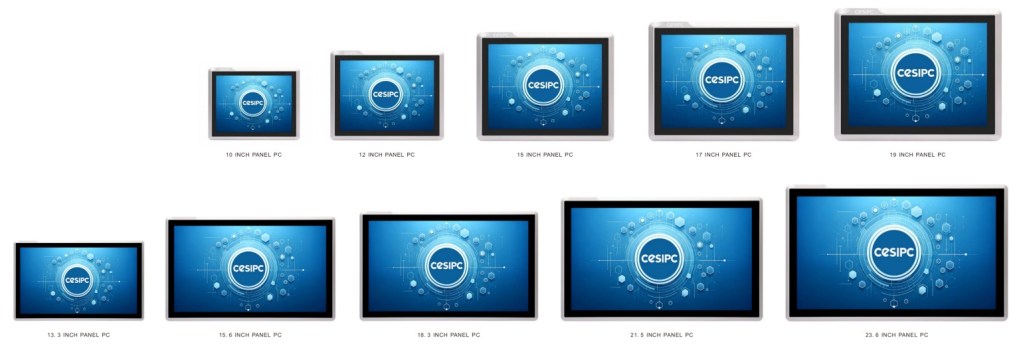
CESIPC IPCs and Panel PCs can be deployed as:
- Machine HMI and operator terminals (Panel PC)
- Cabinet-level supervisory control and data nodes (IPC)
- Platforms designed for long-term continuous operation in industrial environments

Core Characteristics of CESIPC IPC Products in the CNC Industry
1. Industrial Control–Oriented Form Factor
- Optimized for installation inside electrical cabinets
- Single-side, concentrated I/O layout aligned with machine wiring logic
- Support for wall-mounting, DIN-rail, and other industrial installation methods
2. Expansion and Adaptability
- Support for PCI / PCIe expansion
- Compatibility with motion control cards and dedicated function cards
- Flexible combinations of multiple LAN and multiple COM interfaces
3. Platform Control and Long-Term Supply
- Industrial-grade motherboards
- Support for platform version freeze
- Designed for long-term projects and multi-generation equipment lifecycles
4. System and Software Compatibility
- Support for mainstream operating systems such as Windows and Linux
- Compatibility with real-time or near real-time system requirements
- Suitable for PC-based CNC systems, supervisory control, and MES nodes
Division of Roles: IPC vs. Panel PC in CNC Systems
| Product Type | Role in the CNC System |
|---|---|
| IPC (Industrial PC) | Control platform / supervisory system / core computing node |
| Panel PC | HMI / operator interface and display terminal |
In CNC system architectures, IPC and Panel PC are typically used together rather than as replacements for each other.
The IPC focuses on control logic, data processing, and system stability, while the Panel PC is dedicated to human–machine interaction and visualization.
IPC (Industrial PC) – For CNC Control and Supervisory Systems
- PC-based CNC / Soft CNC control platforms
- CNC system runtime environments
- Supervisory control, equipment coordination, and data nodes
Typical Form Factor Characteristics
- Industrial-grade fanless or low-speed fan design, suitable for long-term operation inside electrical cabinets
- Single-side, concentrated I/O layout aligned with machine wiring and maintenance logic (product roadmap)
- Support for PCI / PCIe expansion for motion control cards or dedicated function cards (product roadmap)
- Multiple LAN and multiple COM interface combinations to support CNC and industrial communication scenarios
- Support for platform version freeze and long-term supply
Applicable System Layers
- Control core or supervisory system, depending on the customer’s system architecture
Industrial Panel PC – For HMI and MES Interfaces
- Operator interfaces (HMI) for CNC equipment
- Machine status visualization and parameter management
- Human–machine interaction terminals for MES and production systems
Typical Form Factor Characteristics
- Industrial-grade touch display designed for on-machine and shop-floor operation
- All-in-one integrated design for easy machine and system integration
- Designed to work in coordination with IPCs rather than as a replacement
- Internal low-cable architecture for strong resistance to electrical interference and vibration
- LEGO MODE modular architecture, enabling seamless performance upgrades while maintaining consistent enclosure and cabinet integration
- Designed for long-term stable operation and industrial environment compatibility
Applicable System Layer
- Operation and visualization layer (HMI / MES interface)
Typical Ways CESIPC Participates in CNC Projects
In CNC system or machine tool projects, CESIPC typically participates in the following ways:
- Working with customers to define the role and positioning of the industrial computing platform within the overall system architecture
- Providing suitable IPC and Panel PC form factors as reference platforms
- Supporting system validation, platform freeze, and long-term supply
- Maintaining ongoing collaboration as the customer’s product line evolves
CESIPC places greater emphasis on the long-term behavior of the platform within the system, rather than on single project deliveries.
In CNC control systems:
- The value of the industrial computing platform lies in long-term consistency and controllability
- The product form factor is merely a carrier of capability, not the ultimate objective
Through its two core product categories—IPC and Panel PC—CESIPC participates in and supports the stable operation and continuous evolution of CNC systems.


